A Komondor champion lineage example is useful only when it shows more than impressive names printed beside a puppy’s ancestors. For a serious guardian breed, a pedigree should help a prospective owner understand where the dog’s correct type, stable character, coat, health attention, and working heritage come from. A title may be a meaningful part of that story, but it is never the whole story.
The Komondor is Hungary’s historic flock guardian, bred to make independent decisions and to protect without becoming needlessly unstable. Preserving that heritage requires careful selection across generations. When reviewing a champion pedigree, the question is not simply, “How many champions are there?” The better question is, “What does this particular family consistently produce?”
A Komondor Champion Lineage Example, Read Properly
Imagine a puppy whose three-generation pedigree includes titled dogs on both the sire’s and dam’s sides. The sire may descend from a Hungarian Champion grandfather known for powerful bone, a correct square outline, and the substantial white corded coat expected of the breed. The dam may come from a family in which several dogs earned conformation recognition while also demonstrating the calm, watchful reserve that responsible Komondor owners value.
At first glance, this is a promising Komondor champion lineage example. Yet the real value is found in the supporting details. Are the titles verifiable through recognized kennel club records? Are the ancestors clearly identified with registered names and registration numbers? Has the breeder personally evaluated the family over time, including adult relatives rather than only young dogs at their best? Can the breeder explain why this sire and dam were chosen together?
A thoughtful answer may sound like this: the sire contributes exceptional head type, bone, and confidence, while the dam’s line is valued for balanced movement, correct coat texture, maternal instincts, and reliable household composure. The pairing is intended to preserve type without doubling up on a weakness. That is breeding with a goal, not simply assembling a pedigree with famous names.
What a Champion Title Can Tell You
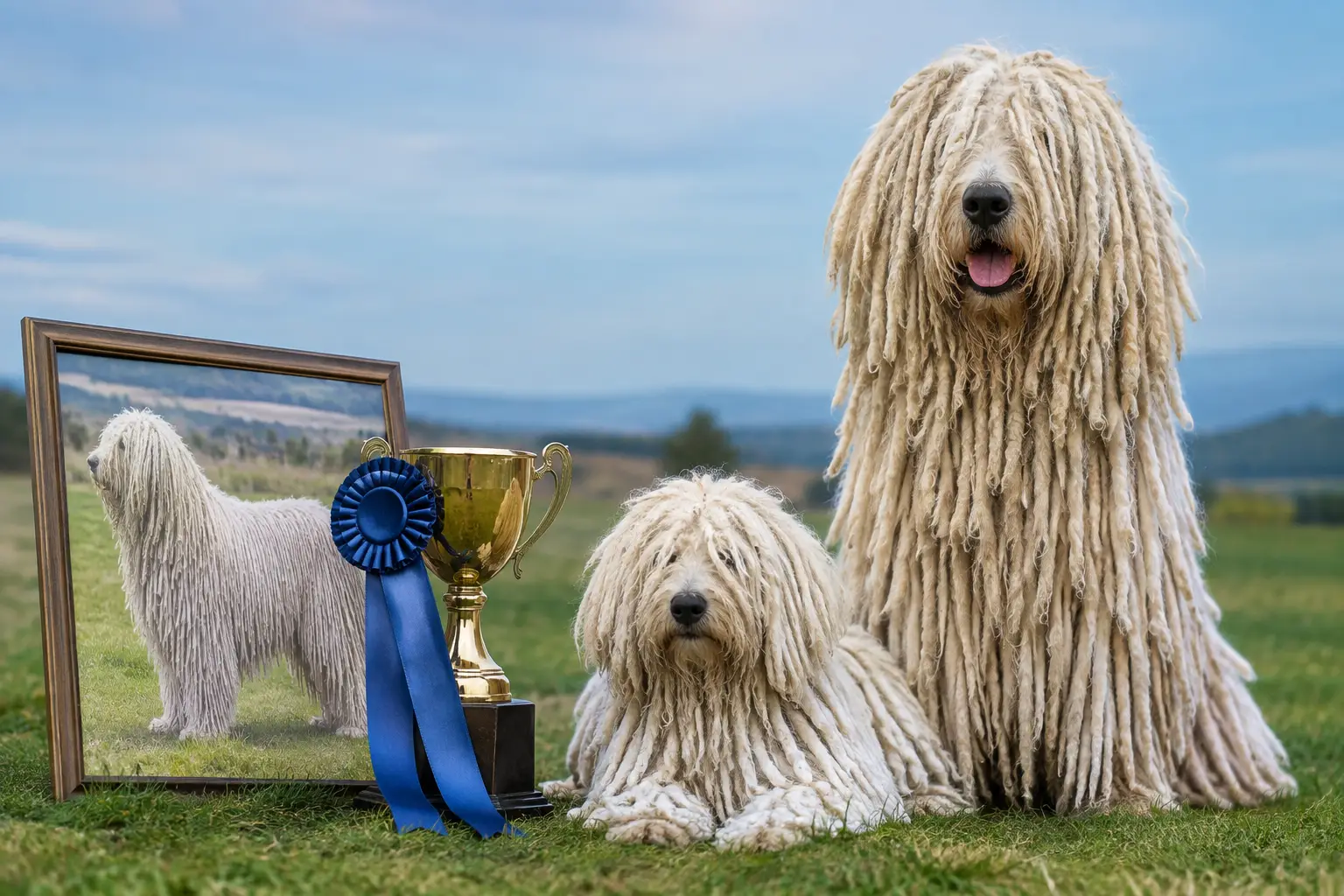
A legitimate championship title usually indicates that a dog was evaluated against the breed standard by qualified judges and was found to have strong breed qualities. In the Komondor, those qualities include imposing but balanced structure, a strong body, correct movement, breed-typical expression, and the distinctive coat that matures into cords.
This matters because a Komondor should not merely resemble a large white dog with a dramatic coat. The breed has a functional design developed for life as a guardian. Correct construction supports sound movement and endurance. Proper coat quality is part of the breed’s identity and historical protection. A composed, self-assured presence is very different from shyness, frantic reactivity, or indiscriminate aggression.
Championships also provide a useful external evaluation. A responsible breeder’s own eye is essential, but show results can show that experienced judges have recognized quality in the breeding program. When several close relatives have earned titles, it may suggest that desirable traits are being reproduced with some consistency.
For international buyers, titles from Hungary and other countries may appear in unfamiliar formats. The letters may differ from American title abbreviations, and the rules behind national championships are not identical. Ask the breeder to explain what each title represents rather than assuming every abbreviation carries the same meaning. Genuine breeders should be comfortable providing clear context and documentation.
What a Champion Pedigree Does Not Guarantee
A pedigree full of champions does not guarantee that every puppy will be a show prospect, an effortless guardian, or the right match for every home. Genetics are not a photocopy machine. Even an excellent pairing produces individual puppies, each with its own development, strengths, and needs.
Titles also do not replace health screening. Structural quality seen in a show ring is valuable, but responsible breeding decisions should be supported by appropriate health evaluations, honest knowledge of the family, and a willingness to avoid repeating concerns. Ask what health information is available for the parents and, where possible, for close relatives. The answer should be specific, straightforward, and proportionate to the breeder’s knowledge.
Temperament deserves the same careful attention. A true Komondor is naturally protective and often reserved with strangers. This is not a breed bred to greet every visitor with instant enthusiasm. However, a guardian temperament should remain stable, manageable, and responsive to the owner’s leadership. Early socialization, daily handling, and proper placement matter as much as inherited instinct.
A puppy from a distinguished line still needs an owner who understands the breed. The Komondor is powerful, intelligent, and capable of making decisions independently. It needs clear boundaries, patient training, meaningful social exposure, and a home prepared for coat care and guardian-breed responsibility. Champion ancestry cannot compensate for an unsuitable environment.
How to Evaluate the Pedigree Behind the Names
Begin with the parents. The puppy’s sire and dam have the most immediate influence, so ask about their structure, temperament, age, health records, and daily behavior. A breeder should be able to describe how each dog acts around family, visitors, other dogs, and normal changes on the property. Photographs are useful, but they should not replace a full discussion of the dogs as living, working individuals.
Then look at the close generations. Grandparents and great-grandparents can reveal whether the family repeatedly produces correct Komondor features or whether the pedigree relies on one celebrated dog far in the background. Repetition is not automatically good or bad. Linebreeding can sometimes reinforce desired qualities when handled by an experienced breeder, but it demands deep knowledge of the family and a clear reason for the choice.
Do not be distracted by a long list of titles without asking what the line is known for. One family may be especially respected for magnificent coat and classic expression; another for powerful movement and substance; another for dependable guardian character. The strongest breeding decisions seek balance. A beautiful head is not enough if movement is poor. Heavy bone is not enough if the dog lacks soundness. A confident dog is not an asset if its temperament is difficult to live with.
Documentation should also match the claims. A reputable breeder can provide pedigree paperwork and explain the registered identity of the puppy and its parents. For an exported puppy, correct documentation matters especially because it follows the dog across borders and becomes part of its future breeding, exhibition, or ownership record. Buyers should know what paperwork is included, when it will be issued, and how transport arrangements protect the puppy’s welfare.
The Value of Hungarian Bloodlines
Hungarian bloodlines carry special meaning for many Komondor enthusiasts because Hungary is the breed’s homeland. That origin alone does not make every individual dog superior, but direct connection to carefully preserved Hungarian families can be highly valuable when the breeder understands the lines and breeds to protect traditional characteristics.
At Somogyi Betyár Kennel, the goal is not to treat a champion pedigree as a sales slogan. It is to preserve the Komondor as a serious, recognizable, sound Hungarian guardian: correct in appearance, stable in mind, healthy enough for a full life, and faithful to the character that made the breed a national treasure.
For a family seeking a companion, the right puppy may be the one with the most suitable temperament and support, not necessarily the one expected to win in a show ring. For an exhibitor or future breeder, detailed lineage and honest evaluation become even more significant. For livestock owners, the conversation should include management, fencing, introductions, and realistic expectations for a maturing guardian dog. The best placement always depends on the purpose of the home.
Questions Worth Asking Before You Reserve
Before reserving a puppy, ask to see the pedigree and have the breeder explain the pairing in plain language. Ask which traits they hoped to preserve, what they consider the parents’ greatest strengths, and what they monitor carefully in the line. Ask about health evaluations, puppy socialization, coat guidance, feeding, training, export documentation, and support after placement.
The quality of those answers often tells you more than the number of champion names. A committed breeder will not promise that every Komondor will behave identically or fit every household. They will speak honestly about the breed’s independence, size, protective instinct, grooming demands, and lifelong need for responsible ownership.
A well-bred Komondor carries history in every generation, but its future is shaped by the care taken before and after it joins a home. Choose a lineage that is documented, understood, and bred with purpose, then give that remarkable guardian the patient leadership and respect it deserves.