


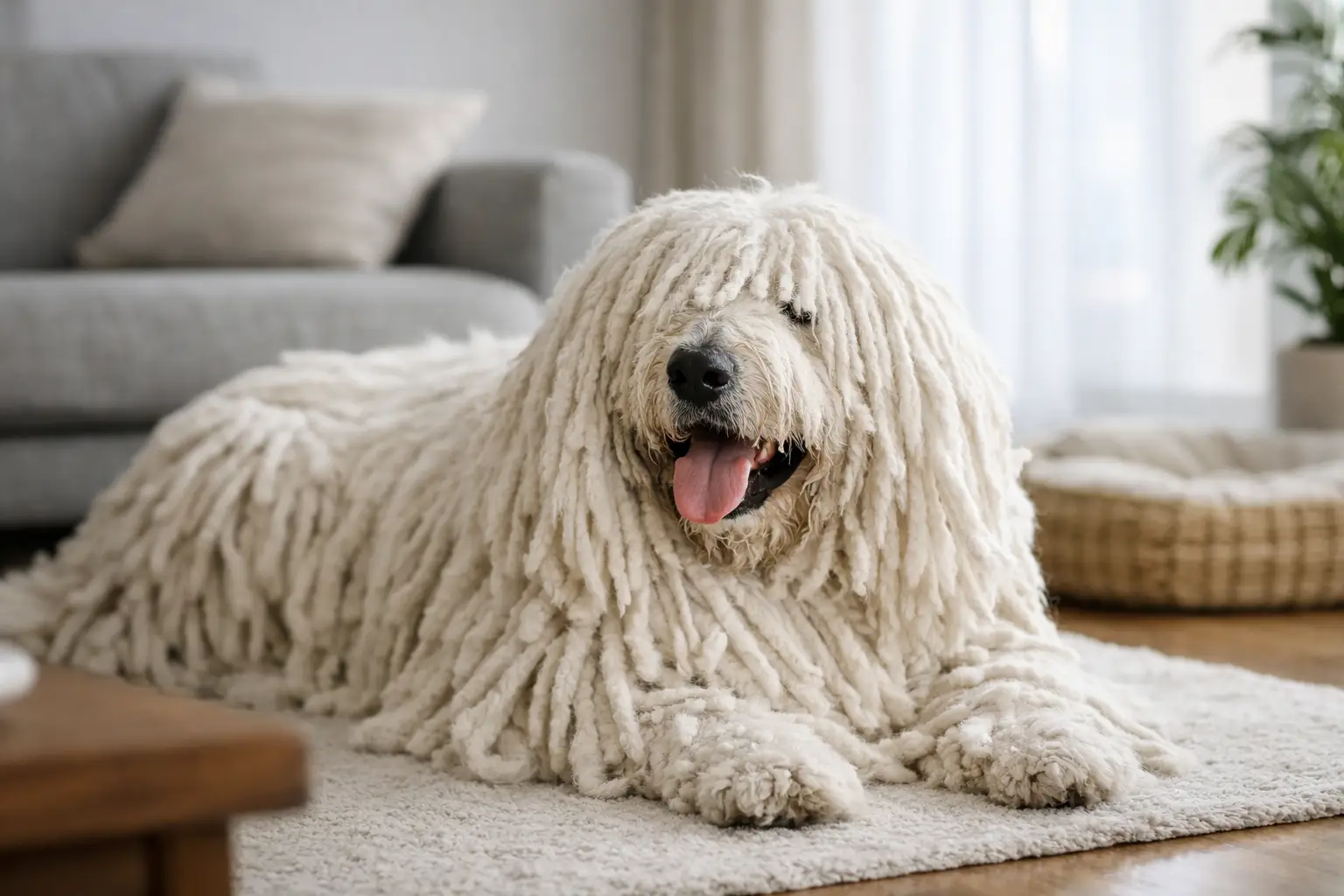
A Komondor resting quietly beside the family sofa can look perfectly at home indoors. Yet the question, can Komondors live indoors, has never been answered by square footage alone. This is a powerful Hungarian guardian breed, developed to think independently, watch its territory, and make decisions without constant human direction. A Komondor can live inside a home, but it must still live a life that respects those instincts.
For the right owner, an indoor Komondor is calm, deeply loyal, observant, and surprisingly settled. For an unprepared owner, the same dog can become bored, overly suspicious, difficult to manage at the door, or frustrated by a life that asks too little of its mind and too much of its patience. The difference is not the dog’s coat or its size. It is the owner’s understanding of the breed.
Can Komondors Live Indoors Successfully?
Yes. Many Komondors live very well as house dogs when they have daily structure, secure outdoor access, early socialization, and clear household rules. They are not dogs that need to pace a yard all day simply because they were historically livestock guardians. In fact, a mature Komondor often prefers to remain close to its people, quietly monitoring the home and resting near the family.
But indoor living should never mean confined living. A Komondor needs room to move comfortably, a reliable place to retreat, and regular opportunities to observe the world in a controlled way. A small apartment with shared hallways, frequent strangers, elevators, and little outdoor access can be challenging, especially for an adult dog with strong territorial instincts. It is not impossible, but it requires unusually committed handling.
A house with a securely fenced yard is generally the more natural arrangement. The yard is not a substitute for companionship or training. It is simply a safe place where the dog can stretch, patrol, enjoy fresh air, and settle according to its nature. Komondors are guardians, not recreational runners. They do not necessarily need endless high-speed exercise, but they do need purposeful daily activity and a stable territory.
The Indoor Komondor Temperament
A well-bred Komondor should be self-assured, devoted, intelligent, and reserved with strangers without being unstable. Those qualities can make the breed an excellent indoor guardian. The dog notices changes in its environment. It is likely to alert the family when someone approaches, and it will take its role seriously.
That seriousness is the trade-off. Komondors do not typically greet every visitor as a new best friend. Owners must take responsibility for introductions, boundaries, and visitor management. A dog that decides it must control the front door, the windows, or the family’s personal space has been given too much responsibility.
From puppyhood, the Komondor should learn that the owner handles guests, deliveries, and unusual situations. Calm exposure to people, vehicles, household sounds, veterinary care, and respectful visitors helps the puppy grow into a stable adult. Socialization does not mean forcing a Komondor to accept attention from everyone. It means teaching the dog to remain composed and responsive while its owner makes the decisions.
This is especially important in a busy household. Children’s friends, repair workers, relatives, and holiday gatherings require planning. A Komondor can be affectionate and gentle with its own family, but no serious guardian breed should be expected to tolerate disorder without guidance.
Space Matters, but Routine Matters More
A large home alone does not create a content Komondor. A dog can become restless in a mansion if it lacks leadership, engagement, and a reliable routine. Conversely, a Komondor in a modest home with a fenced yard, daily walks, training, and a calm owner may be very content.
The practical question is whether the home can support the dog’s size and presence. Mature Komondors are large, strong dogs. They need clear pathways, a bed large enough for their body, and flooring that provides secure footing. Their heavy, corded coat also brings dirt, moisture, and seasonal debris indoors. Families who want an immaculate home with minimal daily cleaning may find the breed’s natural lifestyle difficult to accommodate.
A consistent schedule helps greatly. The Komondor should know when it goes outside, when the household becomes quiet, where it rests, and what behaviors are expected around doors and guests. Predictability reduces unnecessary guarding behavior because the dog does not feel compelled to interpret every event on its own.
Crate training or teaching a designated resting place can be useful, particularly during puppyhood and when visitors arrive. This should never be used as a way to store a large guardian dog for long hours. It is a management tool that gives the dog a familiar, safe place while the owner remains in control of the environment.
Exercise for a Guardian, Not a Sporting Breed
The Komondor’s exercise needs are often misunderstood. This is not a breed designed for repetitive, high-intensity athletic work every day. Forced distance running, endless ball throwing, and extreme exercise can be inappropriate, particularly for growing puppies whose joints and structure are still developing.
What the Komondor needs is regular, sensible movement. Daily walks, time in a secure yard, obedience practice, and calm exploration provide a healthier outlet than trying to exhaust the dog physically. An adult Komondor may enjoy a longer walk or hike with its owner, but the pace should suit its condition, weather, and coat.
Mental work is equally valuable. Short training sessions that reinforce recall, leash manners, place commands, waiting at doors, and calm greetings build a more reliable household companion. Because the Komondor is intelligent and independent, training should be fair, consistent, and purposeful. Harsh handling can damage trust, while inconsistent rules invite the dog to make its own rules.
Puppies need particular care. Their instinct to watch, challenge, and investigate will appear early. A young Komondor should not be encouraged to guard aggressively or treated as a novelty because it barks at strangers. The goal is maturity: a dog that can assess a situation, listen to its owner, and act with stable confidence.
Grooming Is Part of Indoor Living
The Komondor’s famous corded coat is not merely an impressive appearance. It is a traditional protective coat that demands knowledgeable care. An indoor Komondor will bring part of the outdoors inside, especially after rain, snow, or time in the yard. The owner must be ready to check and dry the coat, keep cords separated, and maintain good skin health.
The coat does not shed in the same way as many double-coated breeds, but that does not make grooming effortless. Developing cords must be separated by hand. Mature cords need attention around the skin, ears, legs, and areas where moisture can remain trapped. Bathing and complete drying require time and planning. A wet Komondor coat cannot be treated casually.
For indoor comfort, keep a clean resting area, inspect the coat after outdoor activity, and establish grooming as a normal part of the dog’s routine from puppyhood. The dog should learn to accept handling of its paws, ears, mouth, and coat without resistance. This is essential for care at home and for veterinary examinations.
A structurally correct Komondor with a proper coat and stable temperament is worth preserving, but prospective owners should be honest about the commitment involved. The coat is beautiful because it is functional and traditional. It deserves care equal to the breed’s heritage.
When Indoor Life Is Not the Right Fit
A Komondor may not be the best choice for people who are away from home for long workdays, frequently host unpredictable gatherings, or want a dog that welcomes all strangers without reservation. The breed can also be difficult for first-time dog owners who have not handled large, independent breeds.
It is not fair to expect a Komondor to be a casual pet that simply adapts to every social situation. Nor is it fair to leave one isolated outdoors with little companionship or direction. The strongest placements are with owners who appreciate both sides of the breed: the calm family companion and the serious, watchful guardian.
At Somogyi Betyár Kennel, we believe responsible placement begins with an honest conversation about daily life, not only a preference for the Komondor’s striking appearance. Champion Hungarian bloodlines, correct structure, health testing, and authentic breed character matter deeply. So does making sure each puppy enters a home prepared to guide and respect it for life.
A Komondor does not need to live in a field to be fulfilled. It needs an owner who understands that even when resting at the foot of the bed, this remarkable Hungarian guardian is still watching, thinking, and protecting the family it has chosen as its own.