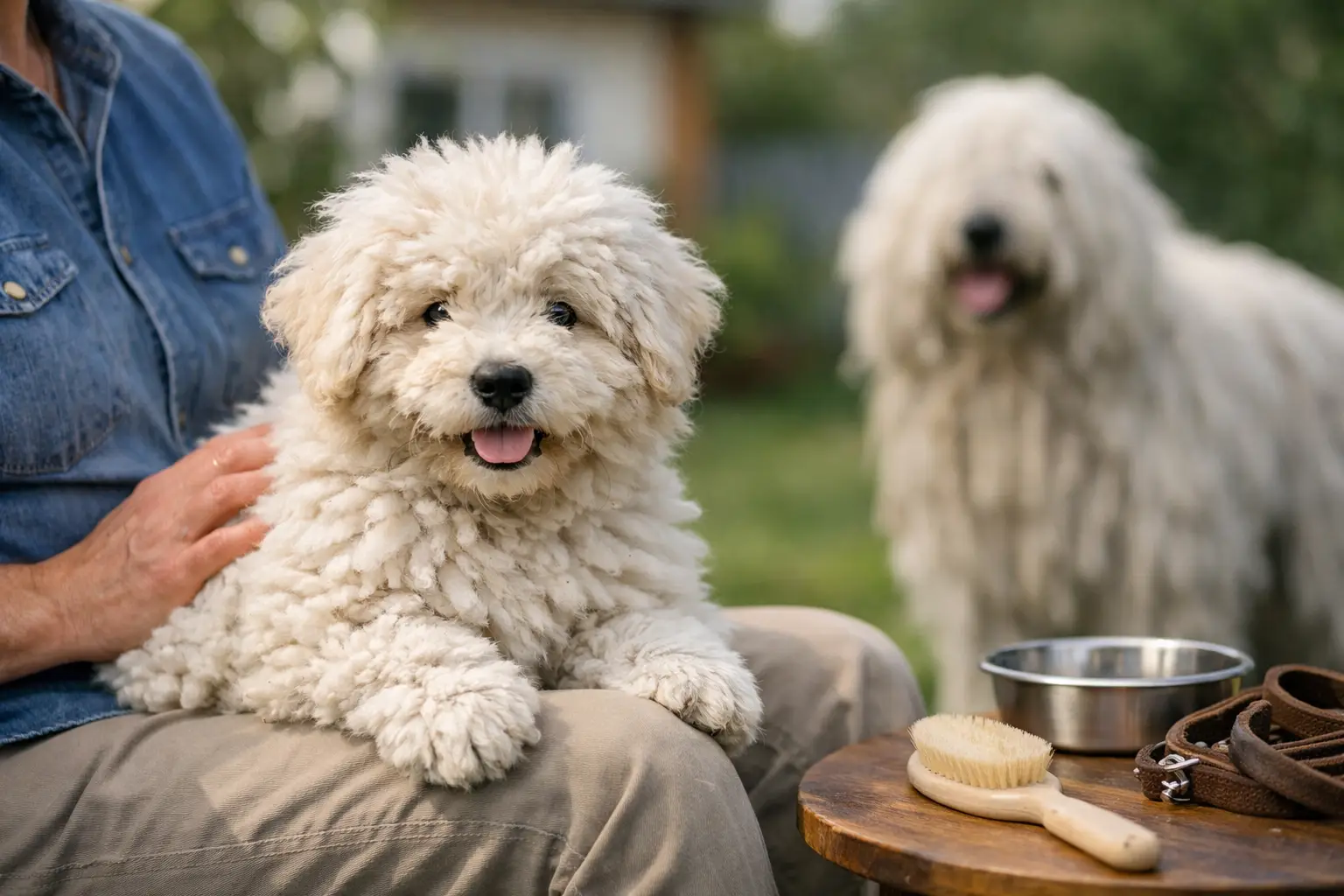
A Komondor puppy may arrive looking like a striking white bundle of curls, but the adult dog you are choosing is an independent Hungarian livestock guardian with centuries of purpose behind him. The right questions before buying a Komondor are not only about price, color, or delivery date. They reveal whether you are ready for a serious guardian and whether the breeder is preserving the breed with the care it deserves.
A well-bred Komondor can be a deeply loyal family companion, a devoted property guardian, and an unforgettable representative of Hungary’s national treasure. He is not, however, a breed selected simply because his coat is unusual. Take time to ask direct questions, listen closely to the answers, and choose with the next 10 to 12 years in mind.
1. Is a Komondor’s guardian nature right for my life?
The first question belongs to the buyer, not the breeder. A Komondor was developed to think independently while guarding livestock, often at night and at a distance from human direction. That heritage is still present in a correct Komondor. He is naturally watchful, reserved with strangers, and capable of making decisions about what belongs on his property.
This does not mean a sound Komondor should be fearful, unstable, or needlessly aggressive. A properly bred and raised dog should be calm, confident, and discerning. But he is not typically a dog who greets every visitor as a new best friend. Families who value a quiet, deeply devoted guardian often find this quality exceptional. Owners seeking an easygoing social butterfly may be happier with another breed.
Consider your home honestly. Do you receive frequent visitors, use dog walkers, host children’s friends, or live under neighborhood restrictions? A Komondor can adapt to many settings with thoughtful management, but his protective instinct must be respected from puppyhood onward.
2. Have I met adult Komondors, not just puppies?
Komondor puppies are charming, but puppies do not show the full physical presence, coat commitment, or mature guardian character of the breed. Ask to see adult dogs from the breeder’s program through a visit, detailed videos, or live communication. Look at their movement, structure, condition, behavior around familiar people, and presentation in everyday surroundings.
This is also the best way to understand size. Mature males are powerful, substantial dogs, and females are still far from small. An adult Komondor has a presence that should inspire confidence without appearing clumsy, weak, or nervous.
3. What health testing and records support this litter?
A pedigree is valuable, but it is not a substitute for responsible health practices. Ask which health examinations have been completed on the parents and request clear documentation. Discuss the family history as well as the individual dogs. A knowledgeable breeder should be prepared to speak openly about health, longevity, structure, and the steps taken to make sound breeding decisions.
Ask what veterinary care the puppy has received, what records will accompany the puppy, and what guidance is provided for the transition to your home. Serious breeders do not treat health paperwork as an afterthought. It is part of the responsibility they accept when producing a rare working breed.
4. Are the bloodlines documented and true to the breed?
For a heritage breed such as the Komondor, lineage matters. The goal should not be merely to produce puppies with white coats and cords. Correct breeding protects the Komondor’s traditional appearance, strong body, working instinct, stable temperament, and unmistakable breed type.
Ask to see the pedigree and learn about the parents and ancestors. Are they from established Hungarian lines? Have they been evaluated in shows, working settings, or both? What qualities did the breeder aim to preserve in this pairing?
Champion titles alone do not guarantee a suitable puppy, but they can be meaningful evidence when paired with health-tested parents, honest breeder knowledge, and generations of correct dogs. Somogyi Betyár Kennel considers this long view essential: each litter should honor the Komondor’s history rather than dilute it for convenience or fashion.
5. How are puppies raised and socialized?
Socialization for a guardian breed does not mean pushing a puppy to accept every person, dog, sound, and situation without thought. It means giving the puppy a stable foundation: appropriate human contact, normal household experiences, careful exposure to new environments, and guidance that builds confidence rather than overstimulation.
Ask where the litter is raised and how puppies encounter daily life. Ask how the breeder evaluates temperament and matches puppies to homes. A breeder who knows each puppy well can offer far more useful guidance than one who allows buyers to choose only by coat or photograph.
Your work continues after the puppy comes home. Early training should focus on calm routines, boundaries, handling, recall, leash skills, and controlled introductions. Harsh methods can damage trust, while permissive handling can allow an intelligent guardian to make too many decisions too soon.
6. Can I manage the coat for the dog’s entire life?
The Komondor coat is magnificent, functional, and not low maintenance. It does not require conventional brushing once cords develop, but it does require regular hands-on care. Cords must be separated, kept clean, and dried thoroughly after bathing or wet weather. Neglect can lead to matting, trapped moisture, skin problems, and a coat that no longer protects the dog properly.
Before committing, ask the breeder to explain the expected coat stages. A young dog changes dramatically as the adult coat develops. Ask how often to separate cords, how to bathe and dry the coat, and whether your climate presents particular challenges. In humid regions or during cold, wet seasons, drying time deserves serious planning.
A Komondor’s coat is not an accessory. It is one of the breed’s defining features, and preserving it properly is part of owning the dog responsibly.
7. What training approach suits this breed?
A Komondor learns quickly, but he is not programmed for repetitive obedience performed solely to please a handler. Training succeeds when it is fair, consistent, purposeful, and started early. He needs an owner who can lead quietly and clearly, not someone trying to dominate him or entertain him every minute.
Ask the breeder what early foundations they recommend and whether they can refer you to trainers who understand independent guardian breeds. Group classes can be useful when carefully managed, but a crowded, chaotic setting is not automatically beneficial. The goal is a composed dog that listens to his family and can move through the world under control.
8. Do I have secure space and appropriate boundaries?
A Komondor does not need endless hours of forced exercise, but he does need secure territory, regular activity, and a clear sense of his home boundaries. A strong physical fence is often a wise investment. Invisible fencing is usually a poor match for a determined guardian because it does not prevent people, wildlife, or other dogs from entering the dog’s perceived territory.
Farm and livestock homes can be excellent placements when owners understand how to introduce a young guardian to animals and supervise his development. Suburban homes can also work well, provided the dog is not left to patrol a fence line and rehearse barking at every passing trigger.
9. What support will I receive after the purchase?
A responsible breeder remains a resource after the puppy leaves. Ask who will answer questions about feeding, coat development, behavior, travel, growth, and adult transition. Ask what happens if your circumstances change and you can no longer keep the dog.
This question reveals a great deal about breeder values. A person committed to the future of every puppy will care where that dog spends his entire life, not only whether the initial sale is completed.
10. If I am buying internationally, how will transport and paperwork work?
For buyers seeking authentic Hungarian bloodlines, international placement can be a practical and worthwhile path, but it should be transparent. Ask about export requirements, age requirements, veterinary documents, pedigree registration, travel arrangements, crate preparation, and communication throughout the process.
The lowest-cost shipping option is not always the safest choice. A young Komondor deserves careful planning that prioritizes welfare, proper documentation, and reliable coordination from departure to arrival. An experienced breeder should explain the process plainly and set realistic expectations.
11. What does the purchase price include?
Price should be discussed directly, without embarrassment. Ask what is included in the quoted amount: pedigree documents, vaccinations, health records, export paperwork, transport arrangements, breeder support, or other services. Also ask about reservation policies and timing.
A well-bred Komondor is the result of health planning, thoughtful pairings, puppy care, documentation, and years devoted to maintaining a genuine breed program. The initial price is only one part of the financial commitment. Quality food, fencing, training, routine veterinary care, grooming supplies, and emergency planning all deserve a place in your budget.
12. Am I choosing this dog for the right reason?
The final question is personal. If the Komondor’s striking coat is what first caught your attention, that is perfectly understandable. Let his character be the reason you stay interested. Choose him because you respect his watchful nature, can give him stable leadership, and want to live with a dog whose loyalty is earned through a real relationship.
The best Komondor homes are not necessarily the busiest or the grandest. They are the homes where this remarkable guardian is understood, guided, and valued for exactly what he was bred to be. A careful conversation before reserving a puppy is the first act of stewardship you can offer your future dog.