A Komondor puppy should never be selected simply because the coat is striking or the breed is rare. Ethical guardian dog breeding begins with a far more serious question: will this dog carry the health, nerve, instinct, structure, and authentic character needed to live as a true Komondor for its entire life?
For centuries, the Komondor protected livestock in Hungary with independence, courage, and remarkable judgment. That heritage cannot be preserved by breeding for volume, fashion, or a quick sale. It requires deliberate selection, honest records, patient puppy raising, and a breeder who understands that every litter contributes to the future of a national treasure.
What Ethical Guardian Dog Breeding Demands
A guardian breed is not a generic family dog with a large body and an impressive appearance. The Komondor was developed to observe, assess, and respond to its environment. A correct dog is devoted to its people, naturally watchful, and capable of making decisions without becoming unstable, needlessly aggressive, or fearful.
This balance is one of the greatest responsibilities in ethical guardian dog breeding. Protective instinct has value only when it is paired with sound temperament. Breeding an overly sharp or anxious dog may create problems that are difficult for any owner to manage. Breeding away the breed’s natural reserve and guardian character, however, creates a dog that may look like a Komondor while lacking the qualities that made the breed exceptional.
The goal is not to produce a dog suited to every household. The goal is to preserve a capable, stable Komondor and place that dog with an owner prepared to provide leadership, socialization, secure boundaries, and respect for the breed’s instincts.
Health Is a Foundation, Not a Selling Point
Health testing is not an optional extra that should be mentioned only when a buyer asks. It is a basic responsibility. Ethical breeders make thoughtful decisions based on the health information available for their breeding dogs, while also considering family history, longevity, orthopedic soundness, and the overall strength of the line.
No breeder can promise that a living animal will never face a health concern. Genetics is not a simple guarantee, and responsible buyers should be cautious of anyone who makes absolute claims. What a serious breeder can do is reduce avoidable risk by testing, studying pedigrees, selecting sound dogs, and refusing to repeat combinations that do not serve the breed.
For a large working guardian such as the Komondor, physical construction matters deeply. Proper movement, strong bones, balanced angulation, and a body built for endurance are not merely show-ring details. They affect comfort, mobility, and the dog’s ability to perform the job its ancestors were bred to do.
Pedigree Is Evidence of Stewardship
A pedigree is more than a document included with a puppy. In the right hands, it is a map of preservation. It allows a breeder to understand the dogs behind a litter, identify established traits, maintain genetic knowledge, and protect the original character of the breed.
Hungarian bloodlines have special importance for those seeking an authentic Komondor. Hungary is the breed’s homeland, and generations of careful breeding have shaped the correct type, coat, working instinct, and presence that serious enthusiasts recognize immediately. Champion titles can offer useful evidence of quality and evaluation, but they should never be the only reason to breed a dog. A title does not replace health, sound temperament, or responsible judgment.
The strongest breeding decisions bring these elements together: documented lineage, proven structure, stable character, breed-correct appearance, and a genuine commitment to the Komondor’s future.
The Komondor’s Coat Must Be Bred and Cared For Correctly
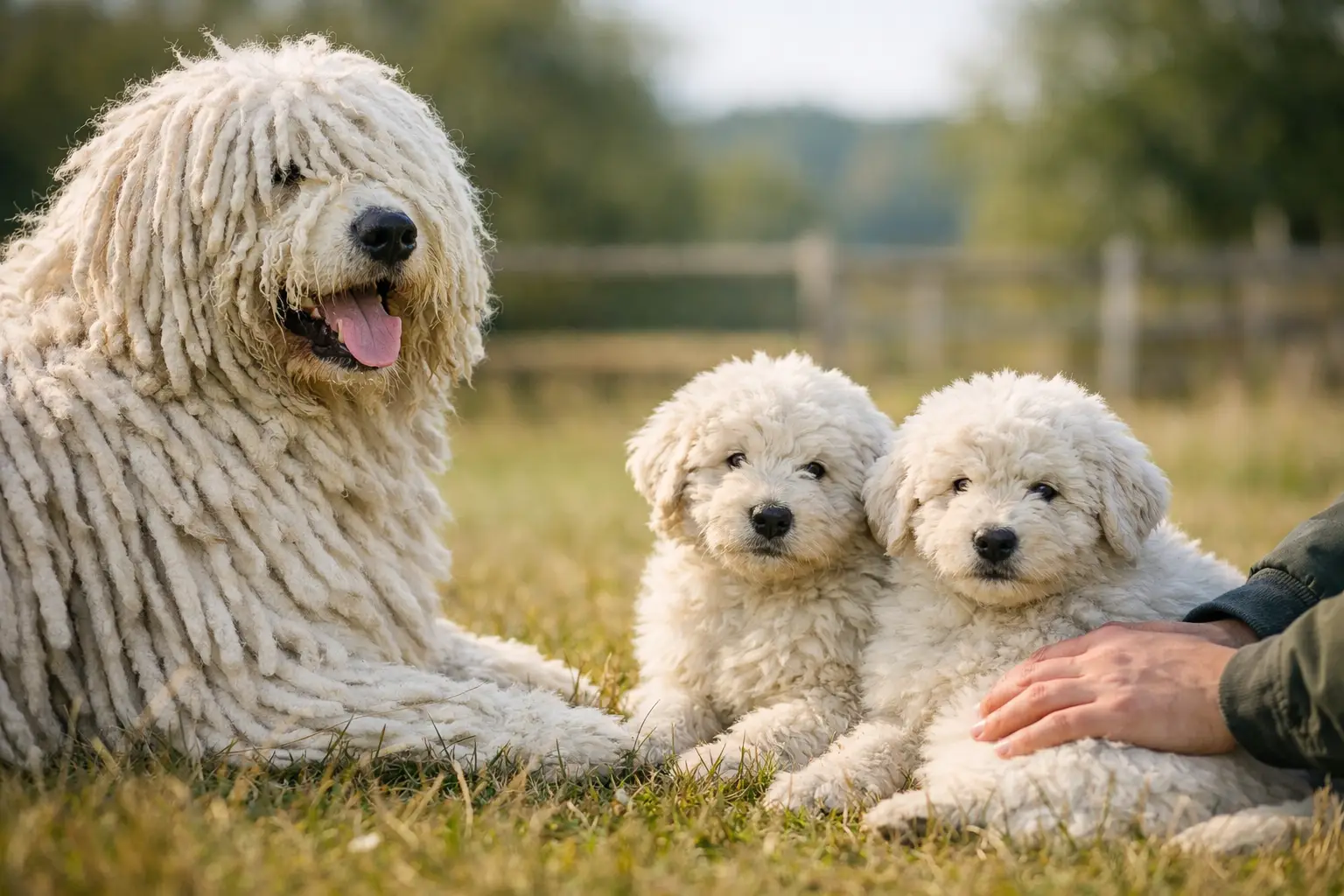
The Komondor’s corded coat is one of the most recognizable silhouettes in the dog world, yet it is often misunderstood. A proper coat is part of the breed standard and its historical function. The dense outer coat and undercoat once helped protect the dog from weather and from the challenges of working around livestock.
Coat quality should be considered in breeding, but a beautiful coat alone is never enough. A dog with dramatic cords but poor temperament, weak structure, or questionable health is not a complete breeding candidate. Ethical selection protects the entire dog, not one feature that photographs well.
Future owners also deserve an honest explanation of coat care before reserving a puppy. The Komondor is not a low-maintenance breed. Cords require regular separation, cleanliness requires attention, and drying a wet coat takes time. Some owners find this work deeply rewarding because it creates a close routine with their dog. Others may find it impractical. Neither answer is wrong, but the decision should be made before a puppy comes home.
Raising Puppies for Their Future Work
Ethical breeding does not end when puppies are born. The weeks spent with the breeder shape the beginning of every puppy’s confidence and adaptability. Puppies need clean conditions, careful observation, appropriate early social experiences, and handling that respects their developing nature.
For guardian breeds, socialization should never mean teaching a puppy that every stranger is a friend or that every situation requires excitement. A well-raised Komondor learns that the world contains ordinary sounds, surfaces, people, and routines. It develops confidence without being overwhelmed and curiosity without losing the calm reserve that belongs to the breed.
This is also why breeder evaluation matters. Individual puppies within the same litter can differ in energy, sensitivity, confidence, and level of guardian drive. A conscientious breeder gets to know those differences and helps match each puppy to the right home. A livestock owner, an experienced guardian-breed household, a serious exhibitor, and a family on a quiet rural property may each need something different.
The right match protects both puppy and owner. It is more responsible to say that a particular puppy is not the ideal fit than to make a fast sale and hope for the best.
How Buyers Can Recognize Responsible Breeding
Buyers should expect a breeder to welcome thoughtful questions. A breeder with nothing to hide can explain the parents, pedigree, health practices, puppy-raising approach, and the likely realities of life with a Komondor. They should provide appropriate documentation and remain available after placement, because support often matters most once the puppy reaches adolescence.
Be wary of pressure to send money immediately, vague claims about rare bloodlines without paperwork, or promises that a guardian breed will be effortless for first-time dog owners. Price alone is not a reliable measure of quality, but unusually low prices often reflect shortcuts in care, testing, raising, or long-term commitment.
International placement requires another level of professionalism. Buyers outside Hungary need clear communication about pedigree paperwork, veterinary requirements, travel arrangements, timing, and safe transport. A responsible breeder treats export as a carefully managed process, not as an afterthought once payment is received. At Somogyi Betyár Kennel, this responsibility includes helping future owners understand both the dog they are choosing and the practical process of bringing that dog home.
The Owner’s Role in Preserving a Guardian Breed
Ethics do not belong to breeders alone. A buyer who chooses a Komondor also accepts responsibility for a rare and powerful heritage breed. Secure fencing, consistent boundaries, thoughtful introductions to visitors, regular coat care, and ongoing training are part of proper ownership.
The Komondor needs a family that values its discernment rather than trying to turn it into a constantly social, indiscriminately friendly dog. It needs enough structure to feel secure, enough purpose to stay fulfilled, and owners who understand that maturity takes time. Many Komondors grow into their full guardian presence gradually, and patience during that process is essential.
For the right home, this breed offers a loyalty that is difficult to describe until it is experienced. A well-bred Komondor does not simply occupy a property. It watches over its people with quiet seriousness, deep attachment, and the unmistakable dignity of its Hungarian heritage.
Choosing a breeder is therefore not just a transaction. Ask to see the evidence behind the promises, ask how the puppies are raised, and ask whether the breeder will still be available when you need experienced guidance. The answers will help you choose not only a puppy, but a future worthy of the Komondor.