

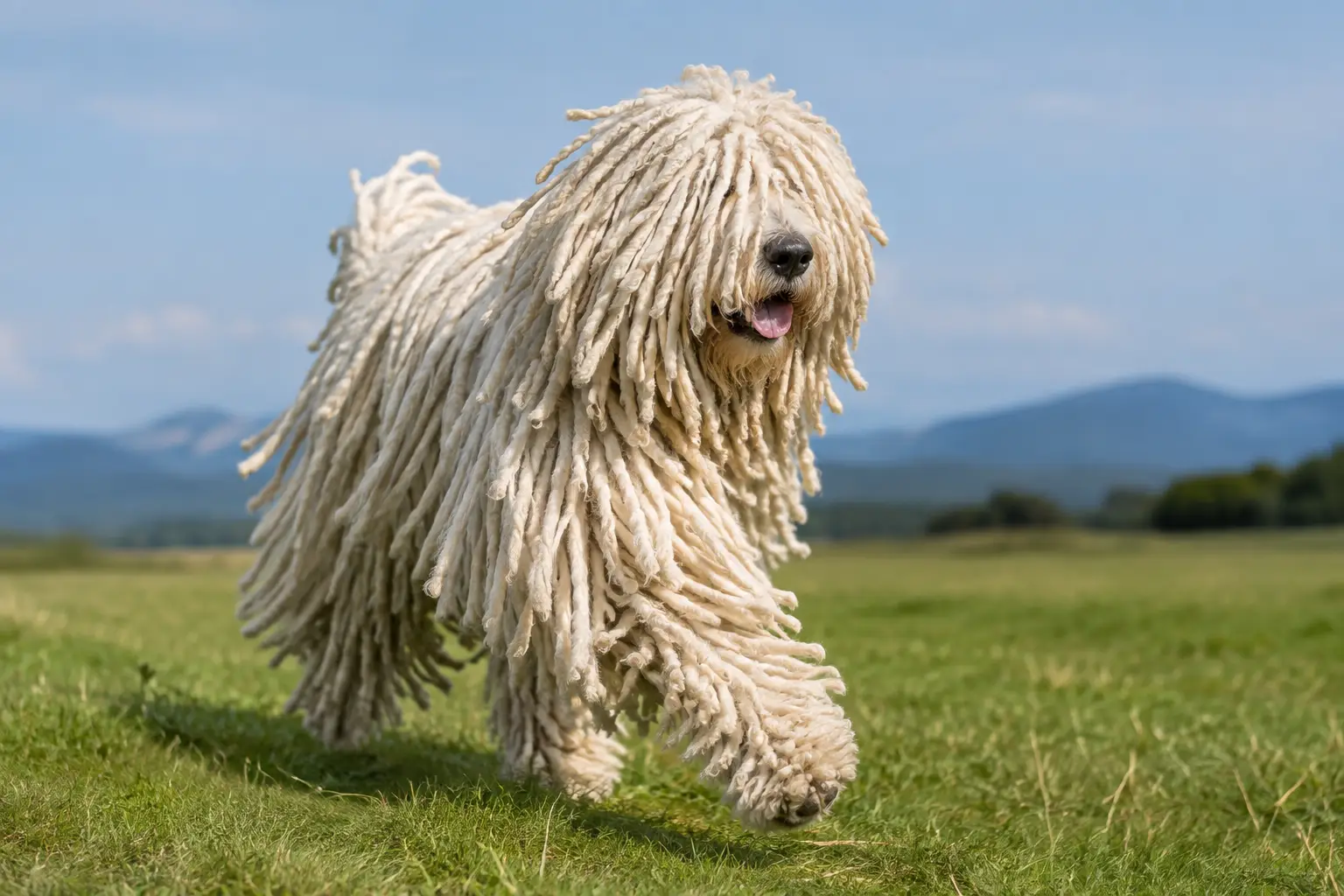
A Komondor watching the edge of a property may appear calm for hours, then move with startling speed when something changes. This is the key to understanding how much exercise does a Komondor need: this historic Hungarian guardian needs meaningful daily activity, but not the nonstop, high-speed exercise expected by many sporting or herding breeds.
The right routine builds fitness, confidence, and good manners without trying to turn an independent livestock guardian into a jogging companion. A mature Komondor usually does best with roughly 60 to 90 minutes of total daily activity, divided between purposeful walks, supervised freedom in a secure area, training, and the natural work of observing its home or livestock. Individual needs vary with age, health, climate, living environment, and the dog’s temperament.
How Much Exercise Does a Komondor Need as an Adult?
For most healthy adult Komondors, one longer walk of 30 to 45 minutes plus another shorter outing is a sensible foundation. Add time in a securely fenced yard or pasture where the dog can patrol, investigate, and settle into its natural role. The goal is not to exhaust the dog. It is to meet both physical needs and the Komondor’s need to understand and monitor its territory.
A Komondor with access to acreage is not automatically exercised simply because it has space. Many guardians choose a favorite observation point and remain there for much of the day. They still benefit from a deliberate walk with their owner, changing scents and surfaces, and calm exposure to the wider world.
On the other hand, an active farm Komondor that routinely moves around a large property and works near livestock may need less formal walking. Its routine can provide substantial movement and mental engagement. Owners should watch the individual dog rather than follow a number rigidly. A dog that is content at home, physically sound, and responsive to direction is usually receiving an appropriate balance.
Purpose Matters More Than Mileage
The Komondor was developed to make decisions independently while protecting flocks. That heritage remains visible in well-bred dogs from traditional lines. Repetitive ball throwing, endless running beside a bicycle, or forced high-intensity games are rarely the best outlet for this breed.
Purposeful activity suits the Komondor far better. A calm leash walk, walking the perimeter of the property together, practicing recall on a long line, or asking the dog to settle while visitors arrive all engage the mind as well as the body. Brief training sessions are especially valuable because they strengthen the owner-dog relationship without challenging the breed’s naturally thoughtful temperament.
The trade-off is clear: a Komondor needs enough activity to avoid boredom and excess weight, but too much repetitive impact exercise can be hard on a large, heavy guardian. Sensible conditioning is preferable to athletic overdrive.
Exercise for Komondor Puppies Must Be Controlled
Komondor puppies are lively, curious, and surprisingly capable, but their large-breed growth must be respected. Long forced walks, repeated jumping, stair running, and jogging are not appropriate for a developing puppy. Their bones, joints, and soft tissues need time to mature.
Short, frequent periods of free play on safe ground are better than a demanding exercise schedule. A young puppy may enjoy several five- to 15-minute exploratory outings, adjusted for age and confidence, along with gentle play and early socialization. Let the puppy set much of the pace. Tiredness, lagging behind, or loss of interest are signals to stop.
Early exercise should also be an education. Teach a puppy to walk calmly on leash, accept grooming, come when called, and settle quietly near the family. A Komondor that learns these skills early is much easier to manage when it becomes a powerful adult guardian.
Adolescence Requires Patience
The adolescent period can test even experienced owners. A young Komondor may have more stamina, stronger opinions, and an increasing awareness of strangers and boundaries. This is not the time to respond with harsh corrections or attempt to wear the dog out physically.
Instead, keep routines consistent. Continue controlled walks, introduce new environments thoughtfully, and require calm behavior before access to exciting activities. Secure fencing is essential. An adolescent guardian that decides to investigate beyond its territory can cover distance quickly, and its protective nature makes unsupervised wandering a serious risk.
The Best Daily Routine for a Komondor
A good Komondor day has structure, not constant entertainment. Many adult dogs thrive with a morning walk, time to patrol or rest in a secure outdoor area, a short training session, and a quieter evening outing. In warmer regions, exercise should happen in the cooler hours of morning and evening.
The famous corded coat deserves consideration here. A properly maintained Komondor coat provides protection, but it also makes hot, humid conditions more demanding. Never assume a dog with a heavy coat can safely exercise in midday heat. Offer fresh water, shade, and rest, and learn to recognize overheating: heavy panting, weakness, dark red gums, confusion, or reluctance to continue are reasons to stop immediately and cool the dog gradually.
Indoor living can work for a Komondor when owners are committed to daily outdoor time and clear boundaries. However, this breed is not ideal for an owner who wants a dog satisfied with brief sidewalk breaks only. A Komondor is most fulfilled when it has a real sense of place, whether that is a family home with a well-secured yard or a working rural property.
Mental Exercise Is Essential for This Guardian Breed
A tired body alone does not create a settled Komondor. These dogs are intelligent, observant, and independent. Their mental work should encourage cooperation without asking them to become something they are not.
Practice practical commands such as come, wait, place, leave it, and quiet. Use food puzzles occasionally, hide treats in the yard, or ask the dog to find a family member in a safe setting. Controlled introductions to trusted visitors also provide valuable guidance. The Komondor should learn that its owner decides who is welcome, rather than feeling responsible for every decision at the gate.
Avoid chaotic dog parks and uncontrolled interactions with unfamiliar dogs. The Komondor is not typically a breed that needs a large canine social circle. Its protective instincts and serious nature call for careful management, especially as maturity approaches. One calm, compatible playmate may be enjoyable, but it is not a replacement for owner-led exercise and training.
Signs Your Komondor Needs a Routine Adjustment
Behavior can reveal whether activity levels are off balance. Restlessness at night, repeated barking without an apparent trigger, destructive behavior, weight gain, or constant pestering may indicate too little stimulation. Increase structured walks and training gradually before assuming the answer is intense exercise.
Conversely, reluctance to walk, limping, prolonged stiffness, excessive panting, or difficulty recovering after activity may mean the routine is too demanding or that a veterinary assessment is needed. Large guardian breeds should remain lean and well conditioned, but they should not be pushed through discomfort.
A sound Komondor is not meant to be restless every minute of the day. One of the breed’s finest qualities is its ability to remain composed, quietly assess its surroundings, and act only when necessary. Owners should value that calmness rather than mistake it for laziness.
The best exercise plan honors the Komondor’s original purpose: give this remarkable Hungarian guardian room to observe, a reason to move, clear leadership, and time to rest beside the people and animals it considers its own. That balance helps preserve not only a healthy body, but the steady, dignified character that makes the breed so exceptional.