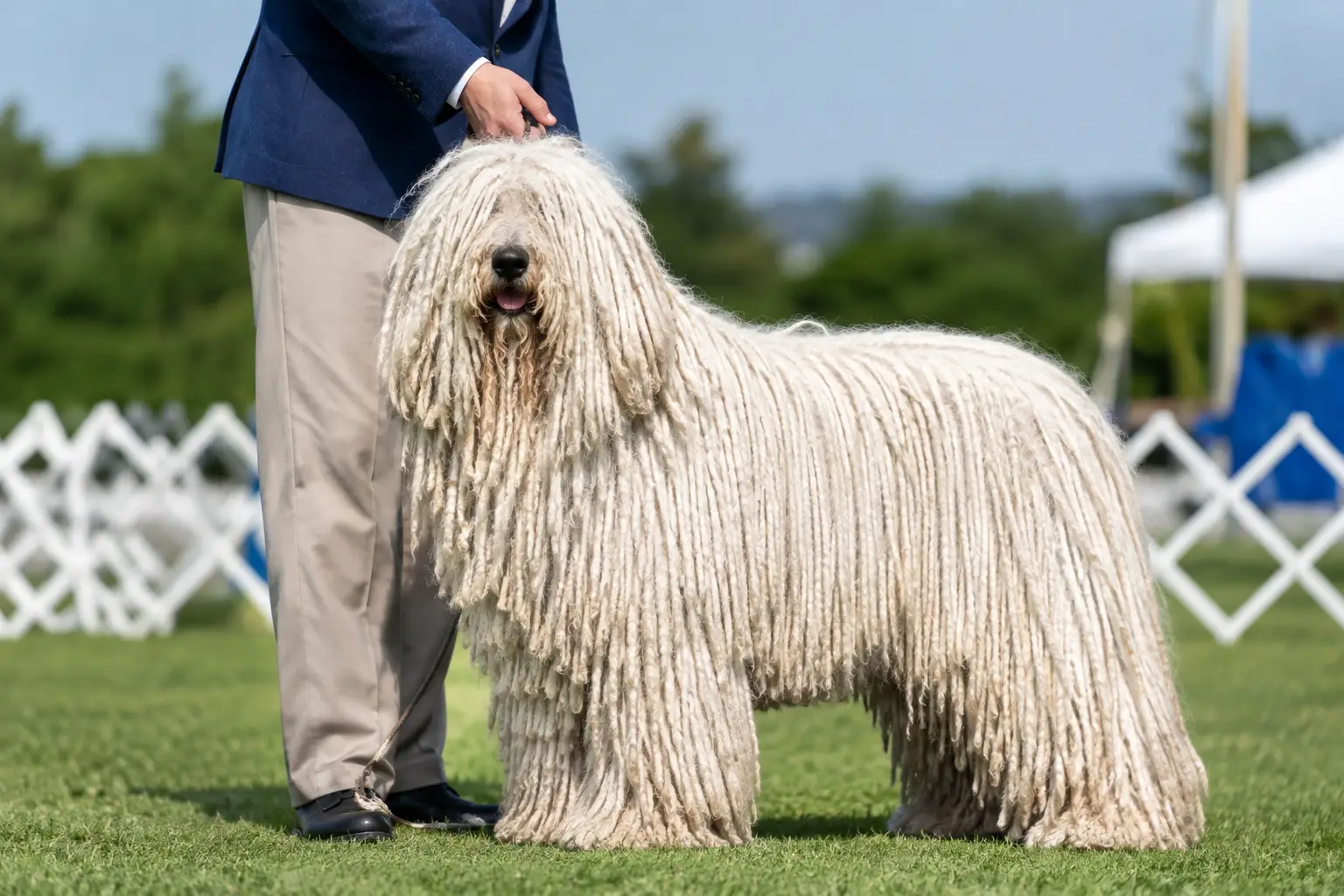
A Komondor standing in the show ring is not being judged for glamour alone. Beneath the striking white cords is a guardian breed shaped by centuries of purpose: alert enough to watch livestock, powerful enough to deter a threat, and stable enough to live closely with its family. That is why Hungarian Komondor show results can be meaningful to a serious puppy buyer – when they are read with a clear understanding of what the results represent.
For families, breeders, exhibitors, and working-dog owners seeking a Komondor from Hungary, a ribbon should never be the whole story. It should be one piece of evidence that a dog has been evaluated against the breed standard by knowledgeable judges. The more useful question is not simply, “Did this dog win?” It is, “What qualities did this result recognize, and are those qualities being preserved in the next generation?”
Why Hungarian Komondor Show Results Matter
The Komondor is Hungary’s national treasure, and the Hungarian breed standard remains the essential reference point for correct type. A well-run show gives breeders an outside assessment of whether a dog carries the silhouette, proportions, movement, coat, expression, and confident character expected of a true Komondor.
A strong result may indicate that a dog has the correct substantial frame without coarseness, a broad and powerful head, dark pigmentation, balanced angulation, and purposeful movement. For an adult Komondor, judges also consider the coat, including its texture and development into the distinctive corded covering that protects the breed in demanding conditions.
These qualities matter because structure has consequences. A dog built with balance is better equipped to move efficiently. A correct coat is not merely decorative. A steady, self-possessed presence is not the same as a show-ring performance, but it supports the breed’s essential dignity. The Komondor should command respect without unnecessary agitation.
Show results are especially valuable when they are consistent over time. One favorable evaluation is encouraging. Repeated placements under different judges, earned in credible competition, tell a more persuasive story about a dog’s quality and reliability as breeding stock.
A Title Is Evidence, Not a Guarantee
It is easy to see a champion title and assume every puppy from that dog will be exceptional. Responsible breeders know the reality is more nuanced. Breeding is the careful combination of two pedigrees, two temperaments, two sets of structural strengths, and two health histories. Even an outstanding show winner is only one half of a litter’s genetic picture.
A title also cannot replace proper health screening, honest pedigree research, early puppy raising, or breeder support. A Komondor puppy needs sound parents, but it also needs thoughtful socialization and a home prepared for an intelligent, independent guardian. The breed’s protective instinct is not an accessory. It requires owners who can provide calm leadership, secure boundaries, and patient education.
For this reason, buyers should regard show records as part of a larger standard of proof. Ask how the sire and dam complement each other. Ask what the breeder values beyond winning. The best answer will connect show quality to breed preservation: correct anatomy, traditional temperament, sound health, functional movement, and the ability to remain recognizably Komondor for generations.
What a Results Page Should Help You Understand
A useful record of results does more than display photographs with trophies. It helps a prospective owner understand the dog behind the award. Look for clarity around the dog’s registered name, pedigree, event level, dates, and titles earned. Context matters. A young dog receiving a promising evaluation is different from an adult consistently competing at championship level, and both can be valuable when presented honestly.
Photographs are helpful, but they should be viewed with care. A single posed image can show presence and condition, yet it cannot reveal everything about movement, temperament, or day-to-day behavior. A serious breeder should be comfortable discussing the dog’s strengths as well as the areas considered when selecting a mate.
The same applies to coat. Komondor coats develop gradually, and age, condition, grooming, and presentation can affect what a viewer sees. A puppy cannot be judged by the same finished-coat expectations as a mature adult. What matters is whether the breeder understands correct coat texture, density, and cord formation and raises each dog with patient, proper care.
The Connection Between the Show Ring and the Farm
Some people create a false choice between a show Komondor and a working Komondor. The traditional breed should not be divided that way. The qualities that make a Komondor impressive in the ring – strength, balance, confidence, correct coat, and breed-specific character – developed because the dog had real work to do.
That does not mean every titled dog has guarded a flock, nor does it mean every farm dog will enjoy exhibition competition. Individual upbringing and opportunity matter. But responsible breeding should respect the original function behind the appearance. A Komondor should never be selected solely for a dramatic coat or a fashionable profile while its stable guardian temperament and physical soundness are ignored.
This is particularly important for international buyers. A Komondor may travel from a rural Hungarian setting to a family property in the United States, a livestock operation, or a carefully managed suburban home. The environment changes, but the dog’s heritage does not. Choosing a puppy from breeders who protect the complete breed gives owners a better foundation for success.
Reading Pedigree Alongside the Awards
A championship record becomes more meaningful when it is supported by a pedigree with depth. Pedigree research allows a breeder to look beyond one celebrated parent and consider the dogs behind it: their type, health, longevity, temperaments, and contribution to the breed.
Hungarian champion bloodlines can offer valuable continuity, especially when a breeder has firsthand knowledge of the families involved. Still, pedigree names alone are not a substitute for judgment. A responsible breeder studies how traits recur and makes selections for the individual dogs in front of them.
At Somogyi Betyár Kennel, this responsibility begins with respect for the Komondor as a heritage guardian, not as a novelty. Show success has value because it can confirm adherence to the breed standard, but the lasting goal is to raise dogs with correct character, structure, coat, and documented lineage for owners who understand what the breed deserves.
When speaking with any breeder, ask to see the pedigree and discuss the parents as living dogs rather than a collection of titles. Are they calm and watchful? How do they behave with their family? How are puppies introduced to everyday handling and new experiences? What health evaluations have been completed? Direct, detailed answers are usually more valuable than impressive marketing language.
Choosing a Puppy Without Chasing a Ribbon
The right Komondor puppy is not always the puppy from the most heavily advertised winner. It is the puppy whose breeding, early care, and expected temperament fit the life you can genuinely provide. A future show home may prioritize conformation potential and coat development. A livestock owner may place greater emphasis on guardian aptitude and an appropriate working environment. A family may need especially careful guidance on management, training, and introductions to visitors.
These goals can overlap, but they are not identical. An ethical breeder will ask questions before promising a particular puppy. They should want to know about your fencing, daily routine, experience with guardian breeds, children, other animals, and plans for training. Such questions are a sign of commitment, not an obstacle to purchase.
International placement also deserves careful planning. Proper export documentation, pedigree paperwork, veterinary preparation, transport arrangements, and communication can make the difference between an anxious transaction and a well-supported beginning. The best breeder remains available after the puppy arrives, because a Komondor owner’s questions often begin when the dog starts settling into its new home.
A show result can point you toward a breeder who takes the Komondor standard seriously. Let it open the conversation, then look deeper: at the dogs, the pedigrees, the health practices, and the breeder’s willingness to stand behind every placement. The right Komondor is not simply a beautiful dog with an award behind it. It is a living continuation of a remarkable Hungarian breed, entrusted to an owner ready to honor its nature.