

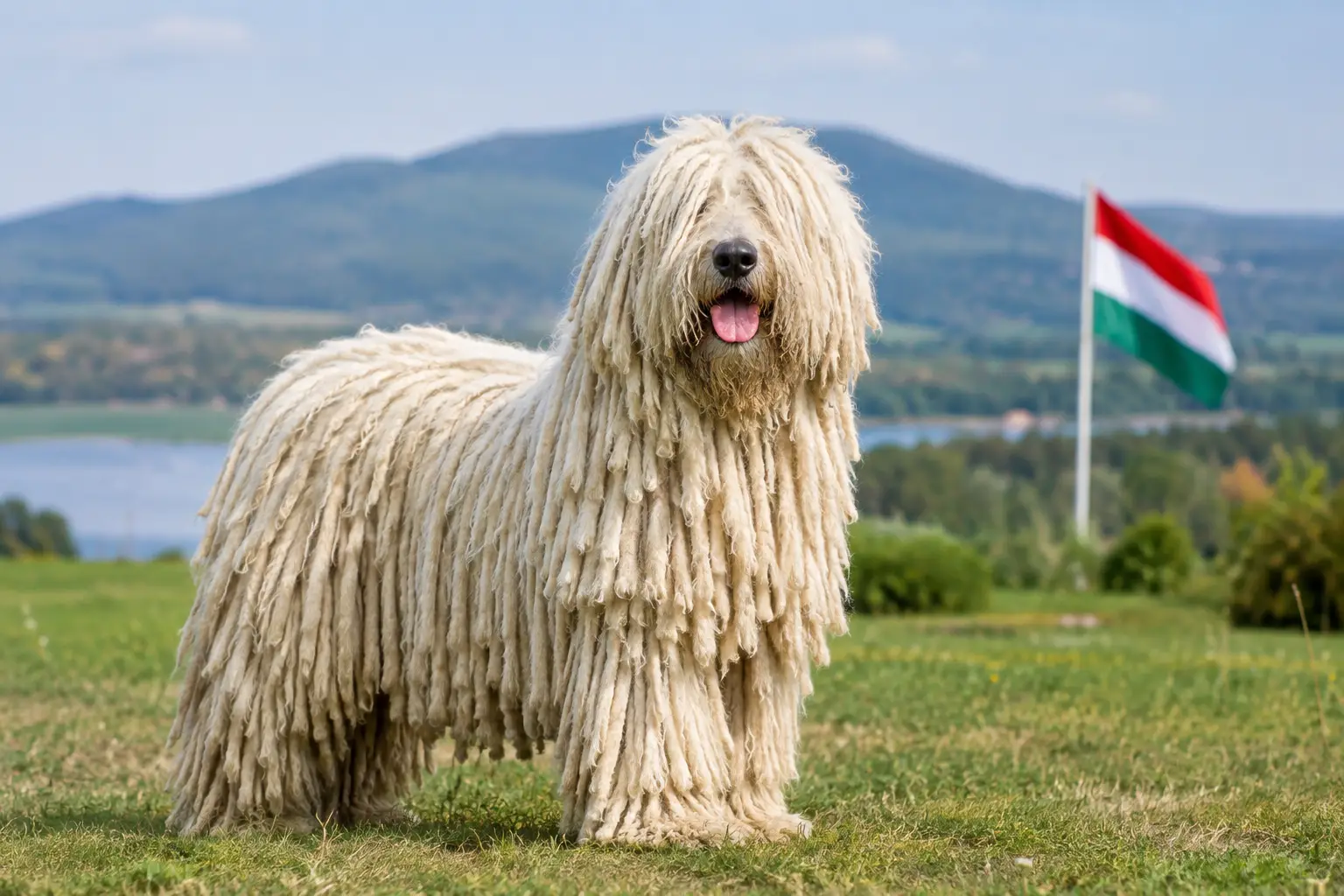
A Komondor is not a dog chosen on a whim. The imposing white cords, quiet watchfulness, and deep loyalty attract attention, but the breed’s true value lies in centuries of purposeful Hungarian breeding. When people consider the best reasons to import Komondor dogs, they are usually looking for more than an unusual-looking puppy. They want confidence that their dog has the heritage, sound mind, correct structure, and breeder support this exceptional guardian breed deserves.
For serious owners in the United States and beyond, importing directly from Hungary can be a meaningful decision. It is not necessarily the fastest route to bringing home a puppy, and it should never be treated as a shortcut. Yet for the right home, direct access to carefully preserved Hungarian bloodlines offers advantages that are difficult to replicate elsewhere.
Best Reasons to Import Komondor Dogs From Their Homeland
You are closer to the breed’s original purpose
The Komondor was developed in Hungary as a livestock guardian, bred to think independently, assess a situation calmly, and stand between its flock and a threat. Those instincts still matter, even for dogs who will live as devoted family guardians rather than work full time with livestock.
A correctly bred Komondor should not be needlessly reactive or eager to please every stranger. He should be self-possessed, observant, courageous, and deeply committed to his own people. Importing from a breeder working within the breed’s homeland can give a prospective owner direct access to dogs selected with this traditional character in mind, rather than simply selected for a dramatic coat or novelty appeal.
This does not mean every imported Komondor is automatically suited to every situation. A guardian breed requires early socialization, firm and fair boundaries, secure fencing, and an owner who respects an independent nature. The benefit is not that the dog will be easy in the conventional sense. It is that the dog can be authentically Komondor.
Documented Hungarian lineage carries real meaning
Pedigree is not decoration. In a rare breed, a detailed pedigree helps a responsible breeder understand the dogs behind a puppy: their conformation, temperament, health history, working qualities, and contribution to the breed over generations.
Hungary remains central to the Komondor’s genetic and cultural history. A puppy from established Hungarian champion lines can connect an owner to breeding programs that have long evaluated the qualities that define the breed. Correct proportions, powerful movement, strong bone, proper head type, coat texture, and stable guardian temperament are all part of that picture.
For future exhibitors and carefully selected breeding homes, this depth of lineage is especially valuable. For family owners, it provides something equally important: assurance that the puppy was bred with a clear understanding of what a Komondor should become as an adult. A pedigree should be transparent, verifiable, and supported by a breeder willing to discuss the dogs behind it honestly.
Correct type protects the future of a rare breed
The Komondor’s corded coat is unforgettable, but it is only one element of breed quality. A sound Komondor has a strong, balanced body built for endurance, a confident but controlled expression, and a coat capable of forming the characteristic cords as it matures. Breeding only for white hair and an impressive puppy photograph can quickly erode the breed’s true type.
Importing from a preservation-minded Hungarian breeder supports a more serious standard. The goal is not to create generic companion dogs that happen to resemble Komondors. The goal is to preserve the complete dog: guardian instinct, physical soundness, distinctive coat, and breed-specific temperament.
That distinction matters for the owner, too. A structurally correct dog is better equipped for an active, healthy life. A well-bred coat has the proper texture and density to cord naturally, although every owner must still learn the necessary care. A faithful representation of the breed is a source of pride, but also a responsibility.
Health-focused selection is worth traveling for
No breeder can promise that a living animal will never face a health problem. Anyone who makes that promise is not speaking responsibly. What a dedicated breeder can do is make informed breeding decisions, use appropriate health testing, know the strengths and weaknesses within their lines, and avoid treating health as an afterthought.
For a large guardian breed, soundness is essential. Prospective owners should expect clear discussion about health screening, age-appropriate veterinary care, nutrition, and the records that accompany a puppy. They should also ask how the breeder evaluates the parents beyond a single test result. Longevity, movement, temperament, reproductive health, and the wellbeing of related dogs all contribute to a more complete picture.
Importing can offer access to breeders who have followed their own lines for many years and who understand the families behind each litter. That knowledge cannot be reduced to paperwork alone. It comes from living with the breed, raising generations of dogs, and accepting responsibility for the choices made.
The Export Process Can Be Personal and Well Planned
International purchase is understandably a concern for many American buyers. A puppy’s welfare must come before convenience. Proper export requires planning around age requirements, veterinary preparation, identification, official documents, flight arrangements, and safe handling from the breeder’s home to the new owner.
An experienced exporter does not leave a family to untangle these details alone. The breeder should explain the process clearly, prepare the pedigree and health documentation, select transport arrangements with care, and remain available when questions arise. Depending on the destination and current regulations, timelines and requirements can vary. A buyer should welcome that transparency rather than expect vague promises.
The wait involved in importing can also be an advantage. It gives a future owner time to prepare a secure home, locate a veterinarian familiar with large breeds, discuss training plans, and learn how to care for a developing corded coat. Bringing home a Komondor should be the beginning of a deliberate relationship, not an impulse purchase completed in a weekend.
You gain a breeder relationship, not simply a transaction
The best Komondor breeders remain invested after a puppy leaves. They want to hear how the dog is maturing, help owners understand developmental stages, and provide practical advice when a young guardian begins testing boundaries or a coat starts forming cords.
This long-term guidance is particularly valuable for first-time Komondor owners. Puppies are affectionate and engaging, but adolescence can reveal the independence for which the breed was created. A breeder who knows the family line can offer context: what is normal reserve, what deserves closer attention, and how to guide the dog without trying to turn him into a breed he is not.
At Somogyi Betyár Kennel, this stewardship is central to every placement. A Komondor puppy represents years of breeding decisions and a living piece of Hungarian heritage. The right home is chosen with the same care used to plan the litter.
A Hungarian import can be the right foundation for serious goals
Some buyers are seeking a guardian for rural property or livestock. Others hope to participate in conformation events, build a carefully considered breeding program, or simply share life with a rare dog of unmistakable presence. An imported Komondor can be an excellent foundation for any of these goals when the puppy is matched thoughtfully to the home.
Still, importing is not automatically the best choice for everyone. If you want a dog who welcomes every visitor, thrives on constant off-leash social activity, or needs little grooming and little direction, another breed may fit your life more comfortably. Komondors are devoted, but they are not indiscriminately social. Their coat is magnificent, but it requires regular hands-on care. Their protective nature is valuable, but it calls for mature ownership.
The right question is not whether an imported Komondor is impressive. It is whether you are ready to honor what the dog was bred to be. For the owner who values documented heritage, guardian character, health-conscious breeding, and a direct connection to Hungary’s national treasure, the journey from Hungary can be the beginning of an extraordinary partnership.