A Komondor puppy may grow into a powerful guardian, a steady family companion, a serious working dog, or a dog that struggles to meet the breed’s traditional purpose. That difference does not come from a pedigree alone, but it begins there. Understanding how champion bloodlines matter helps a prospective owner look beyond an impressive name and choose a puppy bred with intention, documented quality, and respect for the Hungarian Komondor’s heritage.
For a rare guardian breed, breeding decisions carry real weight. The Komondor was developed to think independently, protect its territory and flock, remain calm under pressure, and move with strength beneath its distinctive corded coat. A responsible breeder should preserve all of those qualities together, not chase a fashionable look or produce puppies simply because there is demand.
How Champion Bloodlines Matter for a Komondor
Champion bloodlines matter because they provide a record of dogs that were evaluated against an established breed standard. A championship title is not just a decorative line on a pedigree. At its best, it shows that knowledgeable judges found a dog to be structurally correct, breed-typical, well-conditioned, and worthy of recognition among other quality Komondors.
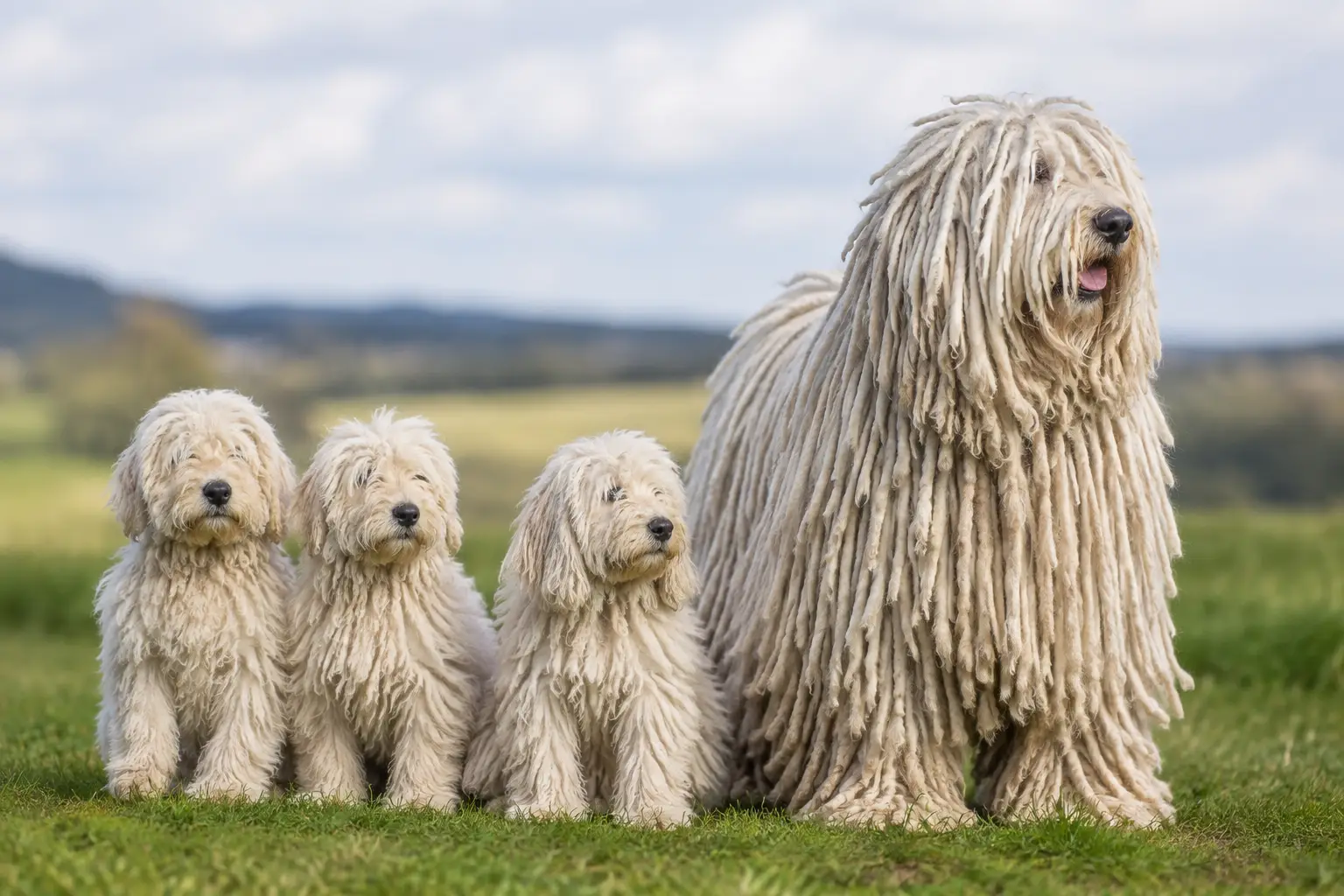
For the Komondor, correct type means much more than a white coat that will eventually cord. It includes balanced proportions, a strong and functional body, proper movement, a characteristic head and expression, and the substance expected of a serious livestock guardian. These traits affect not only appearance in the show ring, but also the dog’s ability to move comfortably, mature soundly, and represent the breed honestly.
A pedigree containing respected champions can also reveal whether a breeder has worked within proven Hungarian lines over generations. That continuity matters. When breeders understand the dogs behind a litter, including their strengths, limitations, temperaments, coat quality, and health history, they can make more thoughtful pairings. The goal is not to repeat a famous name on paper. The goal is to build on proven dogs while protecting the future of the breed.
A title is evidence, not a guarantee
A champion ancestor does not guarantee that every puppy will become a show champion, an ideal guardian, or the perfect match for every home. Genetics are complex, and each puppy is an individual. Environment, training, socialization, nutrition, and owner management all influence the adult dog.
Still, documented champion lines give a buyer something valuable: evidence. They show that the breeder has not selected breeding dogs at random or based only on convenience. When titles are paired with health testing, honest temperament knowledge, and a carefully maintained pedigree, they become one part of a credible breeding program.
What a Strong Pedigree Can Tell You
A pedigree should be read as a family history, not as a marketing slogan. It identifies parents, grandparents, and earlier generations, allowing a serious buyer to see the depth and consistency behind a puppy. In a well-planned Komondor litter, the names on that document should connect to dogs known for correct type and responsible breeding rather than a collection of unfamiliar or unverified ancestors.
Champion bloodlines can indicate consistency in several important areas. They may show a family of dogs with correct outline, solid bone, balanced movement, quality coats, and a recognizable Komondor character. They can also help a breeder avoid losing the traits that make the breed distinct: its dignity, reserve with strangers, devotion to its own people, and natural protective awareness.
The strongest pedigrees are not necessarily those with the greatest number of titles printed in large letters. A thoughtful breeder looks at where those titles come from, what the dogs actually contributed, and whether the same lines have produced sound, stable Komondors over time. A close look at the family matters more than a single celebrated ancestor several generations back.
For buyers outside Hungary, authentic documentation has added importance. It provides confidence that the puppy truly comes from the stated lineage and that the breeder can support the dog’s identity with proper pedigree records. This is particularly meaningful when importing a rare Hungarian breed and making a long-term commitment from another country.
Structure, Temperament, and Working Ability Are Connected
The Komondor is often admired first for its extraordinary coat. Yet the coat should never distract from the dog underneath it. A correct Komondor needs a strong frame, sound feet, balanced angulation, and free movement. Poor structure can affect comfort, mobility, and endurance throughout a dog’s life, especially in a large, substantial breed.
Temperament deserves equal attention. The traditional Komondor is not meant to behave like an eager-to-greet-everyone companion breed. A good representative is self-assured, observant, deeply loyal to its household, and naturally discerning with unfamiliar people. He should be stable rather than nervous, protective without being needlessly reactive, and capable of settling when his owner provides clear leadership.
Champion lines can help preserve this balance when breeders select for temperament as seriously as they select for appearance. However, show success alone cannot fully measure a guardian dog’s character. A breeder must know the daily nature of the dogs in the pedigree. How do they behave at home? How do they respond to visitors, livestock, new environments, and normal household life? Are they confident and manageable? Those answers matter to a future owner.
Working ability is also part of the Komondor’s inheritance. Not every puppy will live with sheep or cattle, and not every owner needs an active livestock guardian. But the breed’s instincts should remain intact. The Komondor’s physical power, independent judgment, watchfulness, and serious presence are not accidental traits. They are the result of generations of purposeful Hungarian breeding.
Champion Lines Do Not Replace Responsible Breeding
Buyers should be cautious of anyone who treats the word “champion” as a complete answer. A quality breeder can explain the health screening performed on the parents, the reasoning behind a pairing, the expected temperament of the litter, and the care given to puppies from birth through placement.
Health testing is especially essential because a beautiful pedigree is not a substitute for responsible health decisions. Prospective owners should ask about the parents’ health evaluations and the breeder’s approach to soundness across generations. Honest breeders also acknowledge that no living animal comes with absolute guarantees. What they can offer is transparency, careful selection, records, and a commitment to stand behind the dogs they produce.
Early raising matters as well. Puppies need clean conditions, appropriate nutrition, age-appropriate socialization, and regular human contact. A Komondor should not be raised as a generic pet product. The breeder should begin preparing each puppy for the real world while respecting the breed’s naturally serious character. Overselling a Komondor as easy, universally social, or low-maintenance does a disservice to both the dog and the buyer.
At Somogyi Betyár Kennel, the purpose of preserving champion Hungarian bloodlines is not to sell a name. It is to place Komondors that carry the substance, traditional character, and documented heritage that this national treasure deserves.
Questions Worth Asking Before You Reserve a Puppy
A reputable breeder welcomes informed questions. Ask to see the pedigree and to understand the dogs behind it. Ask which champions appear in the line, what qualities they were known for, and why the parents were chosen together. If a breeder cannot discuss the actual dogs beyond titles, that is worth noticing.
You should also ask about the parents’ everyday temperaments, health testing, coat development, size, and suitability for your situation. A breeder who knows the breed well will not promise that every puppy is right for every household. A Komondor requires secure boundaries, patient training, thoughtful socialization, regular coat care, and an owner who respects guardian-breed behavior.
For international buyers, clarify the export process early. Proper pedigree paperwork, veterinary preparation, safe transport arrangements, and clear communication are part of responsible placement. The distance between Hungary and a new home should never become an excuse for vague answers or incomplete records.
The right puppy is not simply the one with the most famous ancestor. It is the puppy produced by a breeder who understands why that ancestor matters, knows what has been carried forward, and takes responsibility for what comes next. When champion heritage is joined with health, temperament, structure, and honest guidance, it gives a Komondor owner something far more meaningful than a prestigious pedigree: a genuine connection to one of Hungary’s most remarkable guardian breeds.