A Komondor’s first flight should never begin with a crate purchased the week before departure. This is a powerful, independent guardian breed with a distinctive corded coat, substantial frame, and strong awareness of its surroundings. A proper Komondor travel crate guide must therefore address more than airline dimensions. It must help the dog arrive calm, protected, correctly documented, and ready to begin life with its new family.
For puppies traveling from Hungary to homes in the United States or elsewhere, safe transport is part of responsible placement. The crate is not simply a shipping container. It is the dog’s protected space through airport handling, loading, flight, customs procedures, and the handover to a new owner.
Why Komondors Need a Different Crate Approach
A mature Komondor can be surprisingly large, solid, and athletic beneath the coat. A crate that appears spacious from the outside may be too narrow through the shoulders, too short for a natural standing posture, or too low once the dog’s coat is considered. Conversely, an excessively oversized crate can allow the dog to slide or lose balance during movement.
Temperament matters just as much. A well-bred Komondor should be stable and self-possessed, not frantic or soft-nerved, but even a confident dog can find airport noise, unfamiliar scents, and separation from familiar people stressful. The correct crate offers security without confinement that feels restrictive. It also allows handlers to move the dog safely without needing direct physical control in busy transport areas.
This is especially relevant for families purchasing a puppy from champion Hungarian bloodlines. The care invested in health testing, pedigree selection, early socialization, and correct development should continue through every stage of export. Safe transportation protects the puppy and honors the responsibility of sending a rare heritage breed into a new home.
Komondor Travel Crate Guide: Getting the Size Right
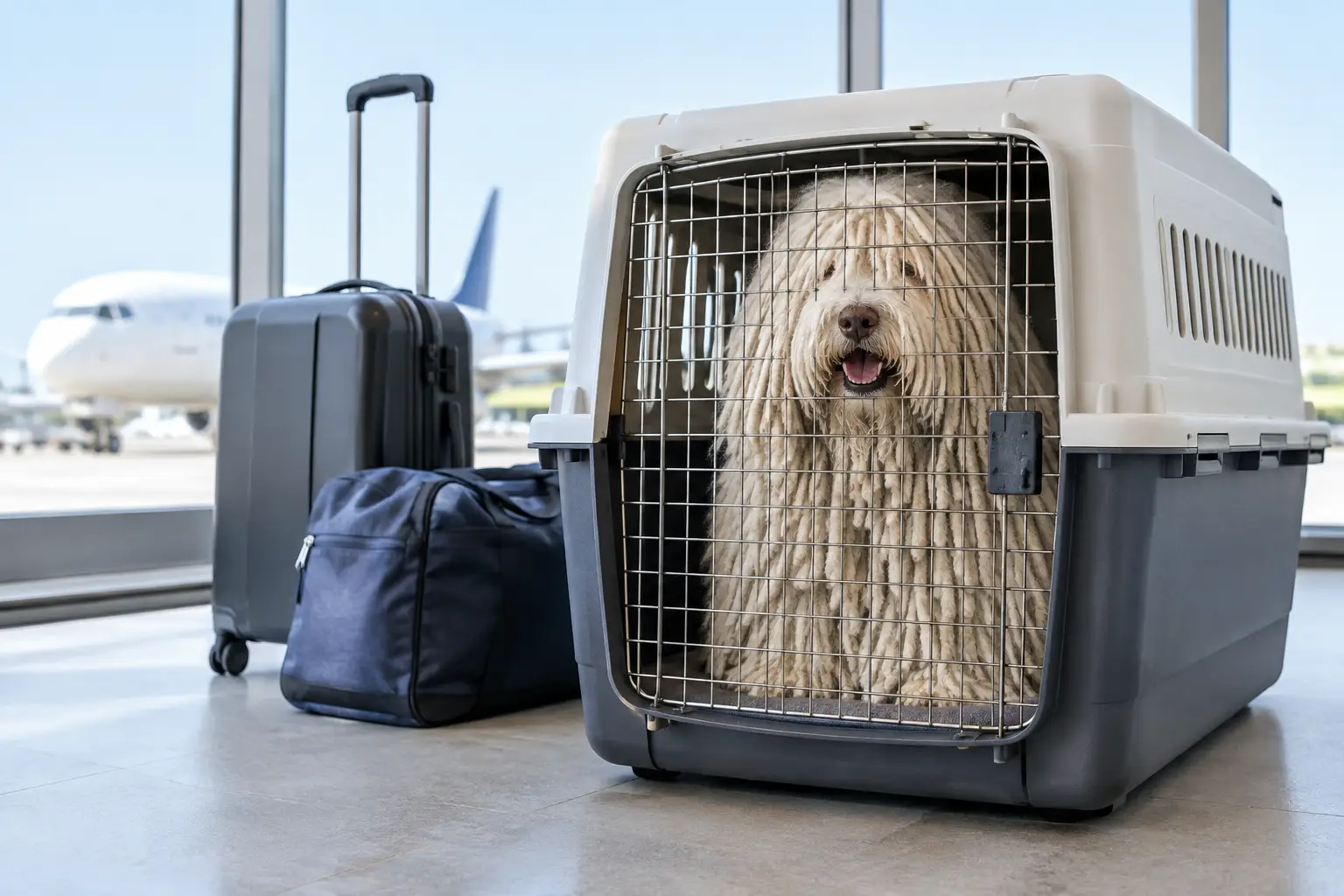
Airlines generally require a dog to stand naturally without the head or ears touching the roof, turn around comfortably, and lie down in a normal resting position. These are the minimum principles, but a Komondor deserves careful measurement rather than a guess based on breed labels such as large or extra-large.
Measure the dog while standing in a relaxed, natural position. Record the length from the tip of the nose to the base of the tail, the height from the floor to the top of the head, and the width across the broadest part of the body. For a coated Komondor, account for the coat honestly. Dense developing cords can add meaningful width and height, particularly around the body and legs.
For young puppies, crate sizing requires a breeder’s judgment. The crate must fit the puppy comfortably on travel day, not the much larger adult the puppy will become. A puppy that slides across a crate that is far too large may be less secure than one in a correctly proportioned space. The crate should still allow normal standing, turning, and resting, with enough room for safe water access.
Adult placements need even more precise assessment. Mature males, in particular, may require a custom-size travel crate rather than a standard retail model. Never assume that the largest crate available in a local pet store meets an airline’s accepted dimensions or construction standards.
Choose a Crate Built for Air Transport
For air travel, use a hard-sided crate designed and accepted for live-animal transport. Airline requirements can differ, and the carrier’s current rules always control the booking. A crate described as airline-approved by a retailer is not a guarantee that every airline, aircraft, or route will accept it.
The crate should have secure, ventilated sides; a solid floor; a strong metal door; and fasteners that meet the carrier’s requirements. Many airlines require metal nuts and bolts rather than plastic clips alone. Wheels may need to be removed or locked, depending on the crate design and airline policy. The door must close securely, while remaining operable by trained staff in an emergency.
Avoid soft-sided carriers for cargo travel, wire crates, damaged plastic kennels, and crates with loose or protruding parts. A Komondor is not a breed for improvised transport equipment. A substantial dog can test weak latches, and a puppy can chew or catch a foot on unsuitable materials.
Inside, use clean, absorbent bedding that will not bunch up, shred easily, or create a slipping hazard. Large blankets and thick pillows may seem comforting, but they can reduce usable space or retain moisture. Water containers should attach securely to the inside of the door and be accessible from the outside for refilling when permitted.
Crate Conditioning Starts Before Travel Day
The best travel crate is still unfamiliar until the dog learns that it is a safe place. Crate conditioning should begin well before travel, using quiet, positive sessions. Start with the door open, allow the dog to investigate freely, and place meals, treats, or a familiar resting surface inside. The goal is voluntary entry, not forced compliance.
Once the Komondor is comfortable entering, build duration gradually. Close the door briefly while remaining nearby, then extend the time as the dog stays relaxed. Short periods of calm rest in the crate are more valuable than a long session that causes distress. Puppies benefit from several brief, pleasant repetitions each day.
A guardian breed should not be pressured into accepting a crate through intimidation. Calm, consistent handling creates better results and preserves trust. The dog should understand that the crate is predictable, secure, and temporary.
Do not use sedatives unless they are specifically prescribed and approved by the veterinarian and the airline. Sedation can affect balance, breathing, temperature regulation, and a dog’s ability to respond normally during travel. In most cases, thoughtful preparation, a suitable crate, and professional travel planning are safer than medication.
Preparing the Komondor for the Flight
Travel arrangements should be confirmed early, particularly on international routes. Airlines may limit the number of live animals accepted on a flight, restrict travel during weather extremes, or impose breed, crate, and connection requirements. Direct flights are often preferable when available because each transfer adds handling and waiting time.
Before departure, confirm the dog’s microchip information, vaccination record, veterinary health certificate, import requirements, pedigree documents, and any country-specific paperwork. Requirements can change, so documents should be reviewed against the destination country’s current rules rather than copied from an old checklist.
On travel day, provide normal opportunities for toileting and calm movement before checking in. Avoid exhausting exercise, heavy feeding immediately before departure, or a chaotic goodbye. A familiar voice and steady handling are more useful than emotional commotion. The dog should travel wearing only what the airline permits. Collars, loose tags, and dangling accessories can create hazards inside a crate.
Attach required identification and travel paperwork securely to the crate exterior according to the airline’s instructions. Include clear contact information for the sending party and receiving owner. Keep duplicate documents with the person collecting the dog, not only on the crate.
Coat Care and Comfort During Transport
A Komondor’s coat requires special attention before travel. The dog should be clean, dry, and free of dampness, debris, or tangled areas that could cause discomfort during a long journey. Wet cords can hold moisture and chill the dog in an air-conditioned environment. Freshly bathed coat should be fully dry well before departure.
Do not attempt a dramatic coat change solely for the flight. Cords are part of the breed’s historic identity and coat management should be guided by the dog’s age, condition, and normal care routine. The practical objective is a clean, dry, comfortable dog with clear ventilation around the body.
When Air Cargo Is Not the Right Choice
Air travel is not automatically appropriate for every dog, route, or season. Extreme temperatures, complicated connections, unsuitable airline policies, a puppy’s age, or an adult dog’s individual needs may call for postponement or a different plan. Responsible breeders do not treat transport as an afterthought or rush a placement simply to meet a preferred date.
The right decision is the one that protects the Komondor’s welfare. That may mean selecting a different flight, waiting for safer weather, arranging a more suitable route, or choosing an in-cabin escort where lawful and realistic for the dog’s size.
A Komondor arrives in a new country carrying far more than a passport and pedigree. The dog carries generations of Hungarian breeding, guardian instinct, and careful human stewardship. At Somogyi Betyár Kennel, we believe the journey should reflect the same respect given to every other part of raising and placing this remarkable breed.