

A Komondor puppy may learn its name, sit, and come when called surprisingly quickly. The more meaningful question is whether that young dog will obey when it believes a stranger at the gate, an unfamiliar dog, or a late-night noise deserves its attention. Are Komondors easy to train? For an experienced, patient owner who respects the breed’s guardian nature, they can be highly trainable. For someone expecting a naturally eager, unquestioning obedience dog, they can be challenging.
The Komondor was developed in Hungary to think independently while protecting livestock. That heritage is not a flaw to train away. It is one of the defining qualities that makes this ancient breed so remarkable. A well-bred Komondor should be intelligent, stable, watchful, deeply loyal to its household, and capable of making sound decisions without constant direction from a person.
Are Komondors Easy to Train for the Right Owner?
Komondors are not difficult because they lack intelligence. Quite the opposite: they are intelligent enough to assess whether a request makes sense in the situation. A retriever may happily repeat an exercise simply because working with its person is rewarding. A Komondor often wants to know why it should do it, particularly once adolescence arrives and its natural confidence begins to grow.
This means training is less about drilling commands and more about building a clear relationship. The dog must learn that you are calm, consistent, fair, and worth listening to. Harshness does not create a reliable guardian. It can produce avoidance, unnecessary defensiveness, or a dog that complies only when pressured. The goal is a Komondor that trusts its owner’s judgment while retaining the steady presence the breed was meant to have.
For owners with experience raising guardian breeds, this approach is usually familiar. For first-time dog owners, the Komondor can be a serious commitment. Their size, protective instinct, powerful bark, and independent character leave little room for casual training or inconsistent household rules.
Start Before the Guardian Instinct Matures
The foundation is laid during puppyhood, long before the dog looks like the magnificent corded guardian seen in the show ring or on a farm. A young Komondor should meet the world in controlled, positive ways: different surfaces, friendly visitors, calm children, vehicles, grooming equipment, veterinary handling, and carefully selected dogs. Socialization does not mean encouraging every person to touch or excite the puppy. It means teaching the puppy that ordinary life is not automatically a threat.
A well-socialized Komondor is not indiscriminately friendly. It is composed. It notices what is happening, takes direction from its owner, and can settle when there is no reason for concern. That distinction matters greatly. The breed should remain reserved with strangers, but reserve is very different from fearfulness or uncontrolled suspicion.
Short, successful lessons are best for a young puppy. Teach its name, recall, leash manners, sit, down, place, wait at doors, and calm handling. Practice these skills in the home first, then gradually in new environments. The important work is not merely whether the puppy can perform a command in the kitchen. It is whether it can remain responsive when a guest arrives or when life becomes more distracting.
Consistency Matters More Than Constant Repetition
Komondors learn patterns quickly. If jumping on a visitor is sometimes allowed, barking at every passing car is sometimes encouraged, or pulling on the leash occasionally gets them where they want to go, the dog receives mixed information. A large guardian breed will eventually make its own rules when people fail to provide dependable ones.
Every member of the household should use the same expectations. Decide early where the dog sleeps, which rooms are permitted, how guests enter, what behavior is expected at the gate, and how the dog is managed around children and other animals. Structure is not cold or restrictive. For a naturally watchful dog, it is reassuring.
Rewards-based training works very well when it is paired with boundaries. Food, praise, play, access to a favorite place, and the chance to greet a family member can all reinforce desired behavior. The Komondor does not need endless treats, but it does need clear feedback. Mark calm, correct choices immediately. If the dog ignores a request, avoid escalating into an argument. Reset the situation, reduce distraction, and make success easier before trying again.
A reliable recall deserves special attention. No guardian breed should be given unrestricted freedom in an unsecured area simply because it knows the word “come.” Build recall with a long line, valuable rewards, and frequent practice. The objective is not to test the dog’s independence by calling once from across an open field. The objective is to create a history of returning to you promptly and willingly.
The Adolescence Stage Requires Patience
Many owners feel confident during the early puppy months, then notice a change between roughly six months and two years of age. The Komondor becomes larger, bolder, and more aware of its territory. It may begin questioning familiar routines, barking more seriously, or showing greater interest in people and animals beyond the property.
This is not the time to stop training because the dog already knows the basics. It is the time to practice them more thoughtfully. Continue supervised exposure to ordinary situations. Ask for calm behavior before opening doors, greeting visitors, getting out of the car, or receiving meals. Give the young dog enough exercise and mental activity, but do not mistake exhaustion for training. A tired Komondor may be quieter for an hour; a properly guided Komondor understands how to behave.
Professional help can be valuable, especially from a trainer who understands livestock guardian breeds and does not treat every independent response as disobedience. The right trainer will help owners read body language, manage introductions, develop practical control, and preserve the dog’s stable confidence. A trainer whose only approach is force or whose only goal is competition-style precision may not be the best match for this breed.
Training a Komondor to Live With Family and Visitors
A Komondor’s devotion to its family can be extraordinary. With thoughtful upbringing, many live peacefully with respectful children, established dogs, and other household animals. Still, no responsible breeder should promise that every individual will enjoy every unfamiliar dog, visitor, or busy social setting. Genetics, early experiences, training, management, and the individual dog all matter.
Visitors should not be left to “make friends” with a guarding dog on their own terms. A sensible routine is better: the owner brings the dog under control, introduces the visitor calmly, and gives the Komondor a clear place to settle. Some dogs are most comfortable observing from a short distance or resting behind a gate during active gatherings. That is good management, not failure.
The same principle applies to property protection. Do not encourage a Komondor to patrol in a state of constant arousal or reward every alarm bark. A dog that alerts its owner and then settles when told has learned a far more useful skill than one that believes every sound requires a full response.
What Makes a Komondor Harder to Train?
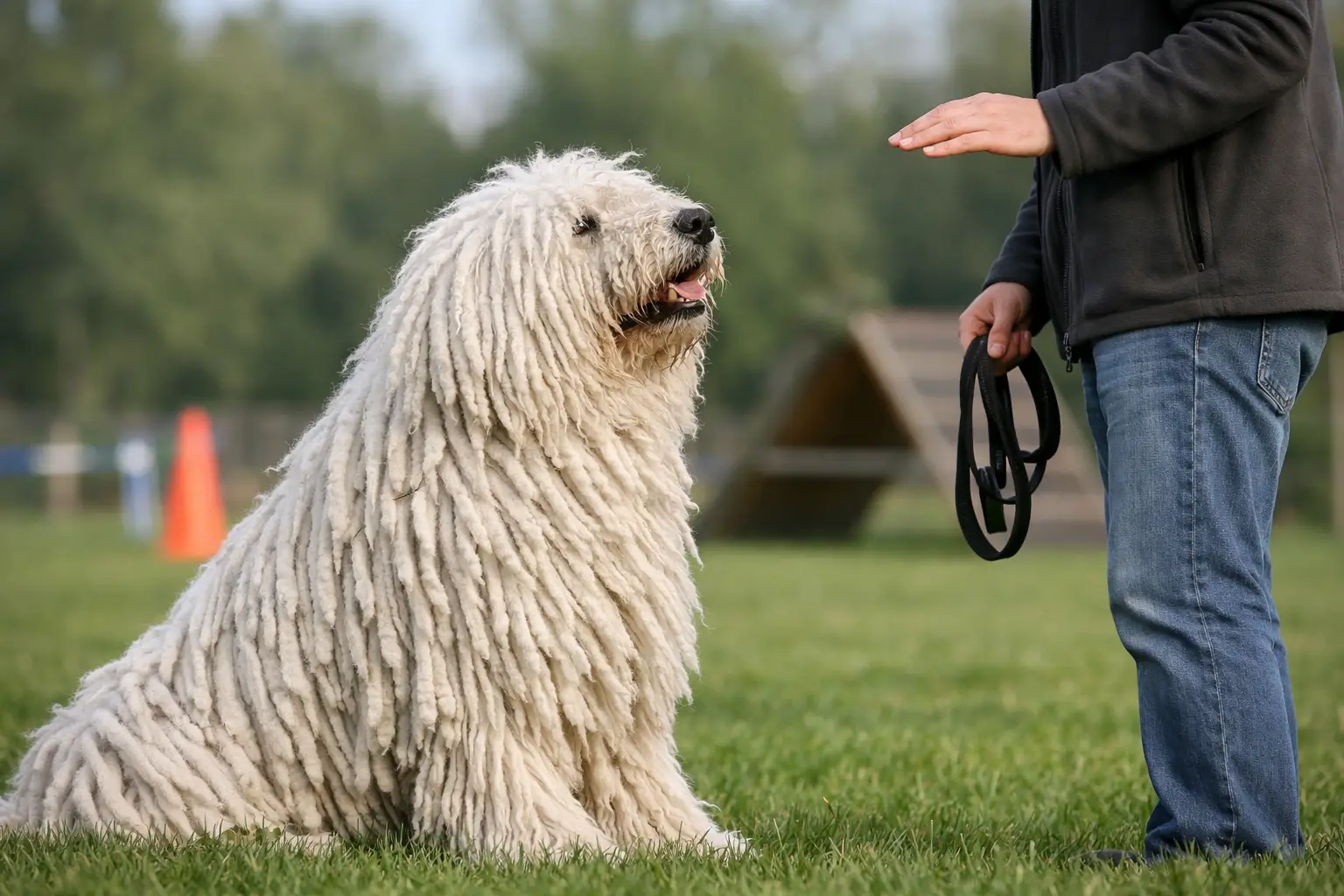
The most common difficulty is not stubbornness in the simplistic sense. It is a mismatch between the dog and the owner’s expectations. Problems often begin when people choose a Komondor for its dramatic white cords and impressive appearance without preparing for the responsibility behind that appearance.
A Komondor may be harder to train when it has too little early socialization, inconsistent boundaries, long periods of isolation, uncontrolled access to a large territory, or an owner who reacts emotionally to barking and guarding behavior. Poor breeding can also make training more difficult. A stable temperament, correct nerve, and sound working character should be priorities in responsible breeding, alongside health, structure, and traditional breed type.
This is why pedigree and breeder guidance matter. A puppy from carefully selected Hungarian bloodlines should come with more than an impressive ancestry. The breeder should understand the temperaments behind those lines, help match puppies to suitable homes, and remain available as the puppy develops into an adult guardian.
The Reward Is a Partner, Not a Performer
A trained Komondor will not necessarily behave like a breed bred to watch your face for the next instruction. Its beauty lies elsewhere. It becomes a calm, devoted companion with the confidence to guard its home, the discernment to settle when you take charge, and the judgment to remain true to its centuries-old purpose.
At Somogyi Betyár Kennel, we believe preserving that character is as important as preserving the Komondor’s unmistakable coat and traditional Hungarian heritage. The right home does not need a perfect dog trainer. It needs an owner willing to learn, establish kind leadership, and give this exceptional breed the time and respect it deserves.
If you can offer that guidance from the first day, training a Komondor becomes more than teaching commands. It becomes the patient work of earning the trust of one of the world’s most loyal guardians.