

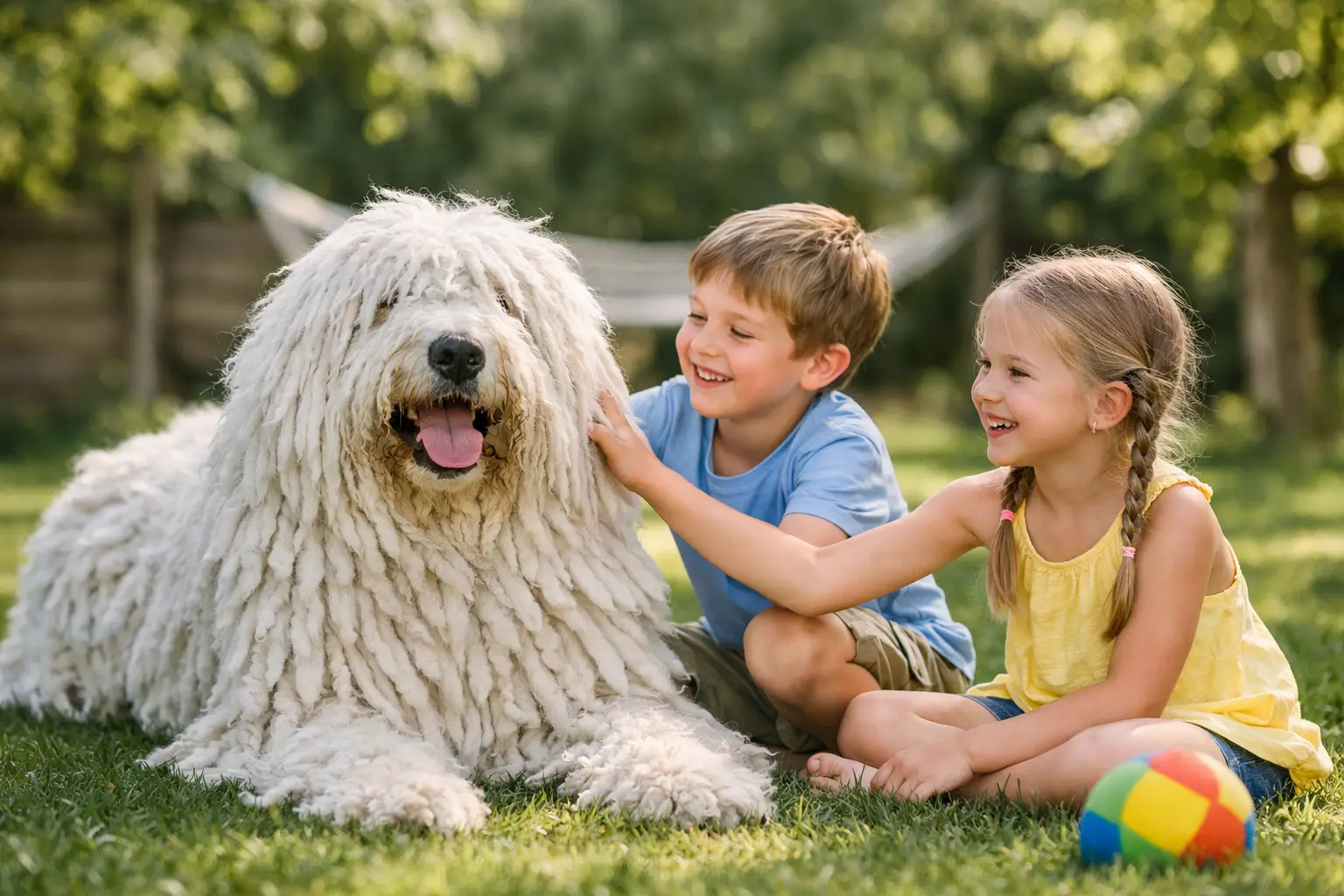
A Komondor standing quietly between a child and the front gate can look like the perfect family guardian. In the right home, that picture can be real. But are Komondors good with children? The honest answer is yes, many are deeply devoted and remarkably patient with the children they know, but this is never a breed to choose simply because it is impressive, rare, or beautiful.
The Komondor is a serious Hungarian livestock guardian dog. Its loyalty is profound, its protective instinct is genuine, and its judgment is independent. A well-bred, carefully raised Komondor can become a steady family companion, but a family must be equally steady in return. Children, parents, visitors, and the dog all need clear boundaries.
Are Komondors Good With Children in Family Life?
A mature Komondor often forms a powerful attachment to its household. Many owners describe their dogs as calm observers indoors, affectionate in their own dignified way, and especially watchful around the family’s children. They are not usually frantic, attention-seeking dogs. Their affection tends to be quiet: staying nearby, checking the yard, resting where they can see the family, and stepping forward when something feels unfamiliar.
That calm presence can be wonderful for children who have learned how to behave around dogs. A Komondor is often more tolerant of ordinary household activity than people expect from such a formidable guardian. Yet tolerance is not the same as unlimited patience. No large dog, regardless of pedigree or temperament, should be expected to accept climbing, pulling, startling, cornering, or rough play.
The breed’s size changes the equation. An adult Komondor is powerful and can accidentally knock over a small child while turning, greeting, or moving quickly toward a perceived concern. Its heavy corded coat can also hide subtle body language from inexperienced children. Families must teach children to respect the dog’s resting space and to leave it alone while eating, chewing, or caring for puppies.
The Protective Instinct Is the Main Trade-Off
A Komondor was developed to make decisions while guarding livestock, often without a person standing beside it. That heritage remains central to the breed. A correct Komondor should be confident, stable, and discerning, not nervous or needlessly aggressive. Still, it will notice changes around the home that a more easygoing companion breed may ignore.
This matters when children have friends over. Running, shouting, wrestling, scooters, unexpected visitors, and excited adults at a birthday party can be difficult for a guardian dog to interpret. A Komondor may see a child’s rough game as a situation requiring intervention. Responsible management is not a sign that the dog is unsafe. It is how knowledgeable owners honor the breed’s original purpose while protecting everyone involved.
For busy homes, introductions should be controlled. The dog should not be expected to greet every child at the door or freely patrol a crowded gathering. Use a secure gate, a separate room, or a calm outdoor area when needed. Give the Komondor a chance to settle before it meets guests, and do not allow visiting children to rush toward or embrace the dog.
A family that wants a dog every child can handle, hug, and take everywhere without thought may be happier with a breed bred specifically for broad social ease. A family that respects a guardian’s nature, values calm structure, and wants a loyal protector may find the Komondor extraordinary.
Breeding and Early Raising Shape the Outcome
Children do not need a softer version of a Komondor. They need a correct one: sound in nerve, stable in temperament, physically healthy, and raised with thoughtful human contact from the beginning. Responsible breeding cannot eliminate the breed’s guarding instinct, nor should it. It can preserve the clear-headed temperament that allows a Komondor to distinguish normal family life from a true concern.
When evaluating a puppy, ask direct questions about the parents’ temperaments. How do they behave with familiar guests? How do they recover from a new sound or situation? Are they confident without being chaotic? What daily experiences do the puppies have before they leave for their homes? Pedigree, health testing, structure, and early care all matter because they support the long, stable life a family expects from a large guardian breed.
At Somogyi Betyár Kennel, preserving traditional Hungarian Komondor character means seeking dogs with sound minds as well as correct coat, working ability, and structure. A puppy should arrive with the foundation for success, but the new owner’s work begins immediately. Genetics provide potential. Daily handling, training, social exposure, and management shape how that potential appears in a family home.
Raising a Komondor Puppy Around Children
The first year is not a time to let a Komondor puppy make its own rules. It is a time to build trust, routines, and calm responses. Puppies are playful, strong, and sometimes surprisingly bold. They need gentle guidance before they become large enough for a careless habit to create a real problem.
Teach the puppy that children moving through the house are normal. Reward calm behavior around noise and activity. Introduce new people gradually and positively, without forcing greetings. A puppy should learn that family members control doors, guests, feeding, play, and access to the yard. This helps the dog understand that it is not responsible for managing every event.
Children also need instruction. They should never take food or toys from the dog, place their faces close to its face, ride it, or disturb it in its crate or bed. They should call an adult if the dog moves away, stiffens, stares, growls, or seems uncomfortable. A growl is communication, not misbehavior to punish. Punishing a warning can remove the signal while leaving the discomfort underneath.
Formal obedience work is valuable, but it should not be mistaken for the whole answer. A Komondor can learn commands well while remaining an independent guardian. The goal is not to make the dog submissive or overly social. The goal is a dog that accepts direction, remains composed, and looks to its family for guidance in unfamiliar situations.
Supervision Is Part of Good Ownership
The safest homes do not rely on a dog’s good reputation or a child’s good intentions. They create routines that prevent mistakes. Young children and Komondors should not be left together without attentive adult supervision, especially outdoors or around food, toys, gates, and visitors.
Supervision also means knowing when to give the dog a break. Komondors need quiet time. Their coat care, grooming sessions, exercise, and rest should be handled calmly and consistently. A dog that has been repeatedly overwhelmed by noise or rough handling may become less patient, even if it has a naturally stable temperament.
As children become older and more respectful, many Komondors become trusted companions in the yard, on family walks, and during everyday life. The relationship is often strongest when it is allowed to grow naturally rather than being demanded. This breed does not need constant entertainment. It needs belonging, purpose, and fair leadership.
Is Your Family a Good Match?
The best match is not defined by the number of children in the home. It is defined by the adults’ willingness to lead. Families do well with a Komondor when they have secure fencing, time for early training and socialization, comfort with managing visitors, and realistic expectations about a large guardian dog. Experience with independent working breeds is helpful, although committed first-time Komondor owners can succeed with breeder guidance and a professional trainer who understands guardian breeds.
It may not be the right choice for a household that is constantly changing, frequently crowded, or unable to separate the dog during high-energy activity. The Komondor deserves a home that sees its protective nature as a responsibility to guide, not a trait to test.
For the family that offers that commitment, a well-bred Komondor can be far more than a striking dog in a white corded coat. It can be a calm, faithful presence beside the children it knows, quietly carrying forward one of Hungary’s most remarkable guardian traditions.