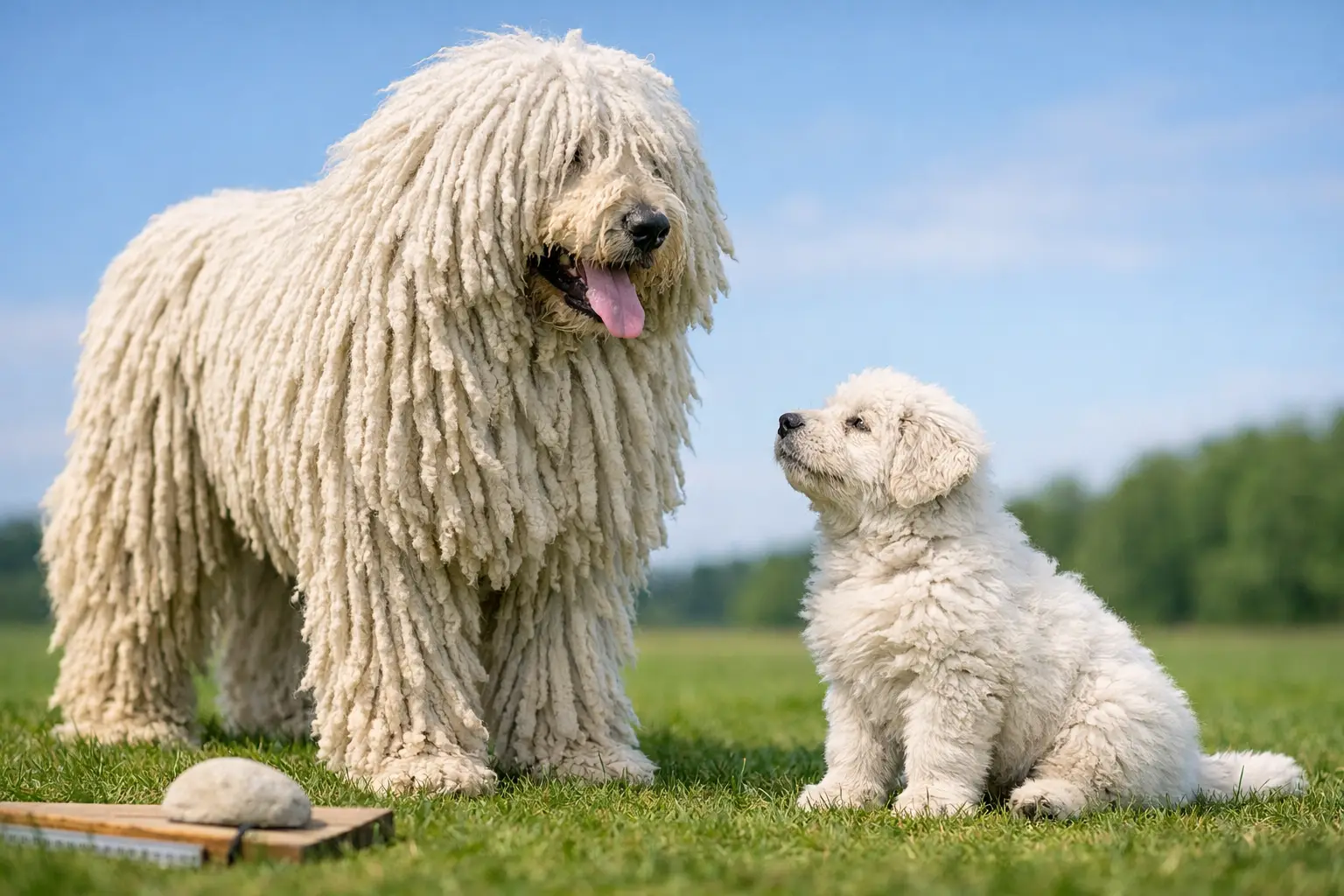
A mature Komondor does not merely look large. Beneath the distinctive white cords stands a tall, substantial livestock guardian with the bone, balance, and quiet physical authority to do the work the breed was developed for. For families asking, how big do Komondors get, the useful answer is not just a number on a scale. Correct height, body proportion, sex, maturity, coat, and conditioning all shape the impressive adult dog you will live with.
A well-bred Komondor should be powerful without appearing heavy or clumsy. The breed’s size is part of its heritage as a Hungarian guardian of flocks and property. A dog that is too small may lack the commanding presence and structure expected of the breed; a dog bred simply to be oversized can lose soundness, agility, and correct type.
How Big Do Komondors Get as Adults?
The Komondor is a giant breed by height and a large, strongly built breed by weight. Adult males generally stand at least 27.5 inches at the shoulder, while adult females generally stand at least 25.5 inches. Many correctly built males fall around 28 to 30 inches or more at the shoulder, and females commonly stand around 26 to 28 inches.
Weight varies more than height because it is influenced by frame, muscle, age, activity level, and coat condition. A healthy adult female may weigh roughly 80 to 100 pounds. Mature males often weigh 100 to 130 pounds, with some substantial individuals weighing more without being overweight. The goal should never be a particular number alone. A Komondor should carry firm muscle over a strong frame, move freely, and remain athletic enough to patrol, turn, and respond with confidence.
The corded coat can make an adult appear considerably wider and heavier than the body beneath it. Visitors often underestimate the dog’s height until they stand beside one, then overestimate its body weight because the coat creates such a remarkable silhouette. A wet Komondor or a young dog before full cords reveals the true outline more clearly.
Size at a Glance
| Sex | Typical Adult Height | Typical Adult Weight | |—|—:|—:| | Female | 26 to 28 inches | 80 to 100 pounds | | Male | 28 to 30+ inches | 100 to 130+ pounds |
These are practical expectations, not guarantees. Serious breeders evaluate individual development and breed-correct structure rather than promising an exact adult weight for every puppy.
Height Is Only Part of Correct Komondor Size
A Komondor is not meant to resemble a tall, narrow dog with a dramatic coat. Correct construction includes a broad chest, solid bone, a strong neck, well-developed hindquarters, and a body that is slightly longer than tall. The dog should be large enough to be imposing, yet balanced enough to move with surprising ease.
This distinction matters when choosing a puppy. Photographs can be misleading, especially when a coat is full or carefully presented for a show. Ask about the parents’ heights, weights, temperaments, working ability, health testing, and pedigree. A breeder committed to the Komondor’s future will discuss the whole dog, not use exaggerated size as a sales point.
Champion Hungarian bloodlines can offer valuable consistency, but responsible breeding still requires thoughtful pairings. Even within an excellent pedigree, puppies may mature differently. One may be a larger, more masculine male, while another develops into a moderate but exceptionally balanced adult. Both can be correct when structure, movement, character, and health are protected.
When Does a Komondor Reach Full Size?
Komondor puppies grow quickly, especially during the first year. Their legs often seem to lengthen overnight, and adolescents can pass through awkward stages where the body and coat have not yet caught up with the frame. This is normal for a guardian breed that takes time to mature.
Most Komondors reach close to their adult height between 12 and 18 months. They continue adding chest depth, muscle, bone density, and adult presence well beyond that point. Many do not look or behave fully mature until they are 2 to 3 years old. Males in particular may continue to fill out after their second birthday.
Coat development follows its own schedule. The puppy coat gradually changes, and cords begin forming as the dog matures. By the time the coat is fully developed, the adult Komondor can look far larger than it did as a young dog, even if its height has changed very little. This is one reason owners should resist judging a youngster’s eventual size too early.
Feeding for Steady, Sound Growth
Fast growth may sound desirable, but it is not the objective. Large and giant breed puppies need a carefully managed diet that supports steady skeletal development rather than excessive weight gain. Keeping a young Komondor lean is kinder to developing joints than allowing extra pounds because the puppy looks charmingly substantial.
Your breeder and veterinarian can help determine appropriate food, portions, and body condition throughout growth. Activity should also be age-appropriate. Puppies need room to explore and play, but repetitive high-impact exercise, forced running, and frequent jumping should wait until the body has matured. A well-raised Komondor becomes a stronger adult through patient development, not rushing.
What a Full-Grown Komondor Means for Your Home
An adult Komondor occupies real space, even before considering the coat. A 110-pound guardian who stands nearly 30 inches at the shoulder can reach counters, lean heavily into trusted people, and block a doorway simply by deciding that doorway deserves observation. The breed needs secure fencing, enough room to move comfortably, and an owner who can physically manage a large dog.
Size also amplifies temperament. Komondors are traditionally independent, observant guardians. A stable, well-socialized adult should be devoted to its family and discerning with strangers, not needlessly reactive. However, a protective dog of this size requires early guidance, clear boundaries, and owners who take socialization seriously. The question is not only whether a home has enough square footage. It is whether the household is prepared to lead a rare, intelligent guardian with consistency and respect.
The coat adds another practical consideration. Cords require hands-on separation and thorough drying after bathing. Grooming is not about making the dog ornamental. It preserves skin health, comfort, and the traditional coat that protects the Komondor in demanding conditions. Prospective owners should expect a large dog’s grooming work, food costs, veterinary expenses, crate requirements, and transport needs.
Why Responsible Breeding Matters More Than Maximum Size
The most impressive Komondor is not necessarily the tallest or heaviest one. It is the dog whose physical scale serves sound function: a correct head and expression, stable nerves, strong movement, durable joints, healthy skin and coat, and the unmistakable calm confidence of the breed.
At Somogyi Betyár Kennel, preserving these qualities begins with respect for the original Hungarian Komondor. Health-tested breeding stock, documented pedigree, thoughtful selection, and honest guidance give future owners a clearer picture of what their puppy may become. For international families, this care also extends to proper paperwork, preparation, and safe transport planning.
Common Questions About Komondor Size
Are Komondors bigger than they look in photos?
Usually, yes. Their height is difficult to judge without a person or familiar object for scale, and the mature corded coat creates a much larger visual outline. Meeting an adult Komondor in person is the best way to understand the breed’s presence.
Do female Komondors stay much smaller than males?
Females are generally shorter and lighter, but they are still large, capable guardian dogs. A well-built female may be more moderate in frame while retaining the strength, courage, and traditional character expected of a Komondor.
Can I predict my Komondor puppy’s adult size?
The parents provide the best starting point, along with the strengths seen across the pedigree. Still, no responsible breeder can guarantee a precise final height or weight. Growth rate, sex, nutrition, and individual genetics all matter.
A Komondor should grow into a dog that makes you pause when it rises at the gate, then reassures you when it settles quietly beside its family. Choose for that complete picture: authentic breeding, sound character, correct structure, and a lifelong commitment to the remarkable guardian behind the cords.