


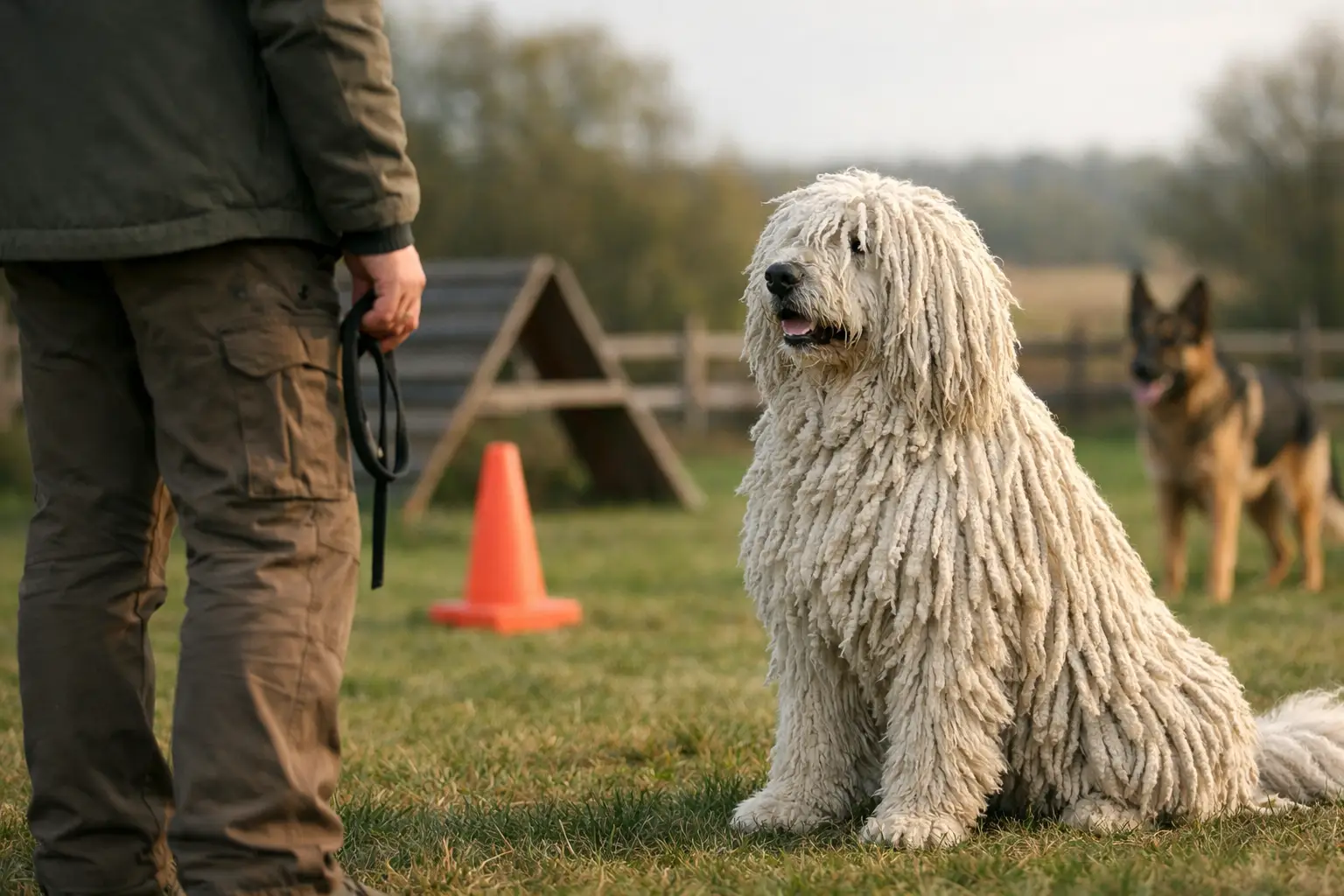
A Komondor puppy may arrive as a soft, curious bundle of white curls, but the adult dog within him is a serious Hungarian guardian. Komondor training is not about making this breed behave like a carefree social butterfly. It is about raising a dog who is secure, responsive, discerning, and deeply trustworthy in the home, on the property, and around the people entrusted to his care.
The Komondor was developed to think independently while protecting livestock. That heritage is one of the breed’s greatest strengths, but it also means owners must provide calm, consistent direction from the first day. A well-raised Komondor should not be nervous, chaotic, or needlessly confrontational. He should possess stable confidence, recognize his family’s leadership, and understand when protection is needed and when it is not.
Komondor Training Starts With the Right Foundation
Training begins long before formal obedience exercises. It begins with the puppy’s daily experience of people, household routines, handling, surfaces, sounds, travel, and boundaries. A puppy from thoughtfully selected, stable Hungarian bloodlines has an important advantage, but genetics alone do not raise a reliable adult guardian. The owner’s work matters every day.
For the first several weeks at home, keep life structured without making it overwhelming. Let your puppy see the normal world in a controlled way: calm visitors, vehicles passing outside, household appliances, children behaving appropriately, veterinary handling, and short trips away from home. The goal is not to introduce him to every person and dog he may ever encounter. The goal is to teach him that new things can be observed without fear or excitement.
A Komondor should never be pushed into greetings with strangers simply because someone wants to pet him. Respectful exposure is different from forced interaction. Allow the puppy to watch, process, and choose a calm response. Praise quiet curiosity and neutral behavior. This builds the judgment that makes a mature guardian valuable.
Start house training immediately, with a predictable schedule for meals, outdoor breaks, rest, and play. Crate training can be useful when introduced positively, especially for safe travel, veterinary recovery, and managing a young dog indoors. The crate should be a peaceful resting place, not a punishment for normal puppy behavior.
Teach Cooperation, Not Blind Submission
The Komondor is intelligent, but he is not a breed that performs for endless repetition. He notices inconsistency quickly and may question commands that seem pointless. This does not mean he is stubborn in a simplistic sense. It means training must be fair, clear, and relevant.
Use short sessions, usually five to ten minutes, and finish while the puppy is successful. Begin with his name, recall, sit, down, wait, leash manners, and a reliable release cue. Practice these skills in ordinary moments rather than only in formal sessions. Ask for a sit before meals, a wait before passing through a door, and a recall before play resumes in the yard.
A calm voice, precise timing, and meaningful rewards will take you further than confrontation. Food rewards are helpful during early learning, but praise, access to the yard, a favorite toy, or permission to greet a family member can also become valuable rewards. What matters is that the dog understands exactly which behavior earned the result.
Avoid drilling a command until the puppy becomes bored or resistant. Ask once, help him succeed if needed, reward the correct response, and move on. Consistency creates respect. Harshness often creates avoidance, defensiveness, or a dog who obeys only when pressured.
Recall Is a Safety Skill
Every Komondor should learn to return promptly when called, even though a guardian breed should not be expected to have the same off-leash freedom as a sporting dog in public spaces. Practice recall first in the home, then in a secure yard, and later on a long line in new but controlled locations.
Never call your puppy to punish him, end every enjoyable moment, or scold him for taking too long. If he comes to you, make returning worthwhile. A strong recall can prevent a dangerous encounter, stop a young dog from investigating beyond a boundary, and make everyday management easier.
Leash Manners Protect Everyone
A full-grown Komondor is large, powerful, and impressive. Loose-leash walking is therefore not optional. Begin before your puppy has the strength to pull you. Reward him for walking near you with a loose lead, change direction before he becomes fully committed to pulling, and do not let him learn that forward motion is the reward for dragging his owner.
If your future role for the dog includes livestock, large acreage, or a working environment, leash training still matters. Veterinary visits, travel, grooming, shows, and emergencies require a dog that can be handled safely and confidently.
Socialization Must Respect the Guardian Instinct
One of the most common mistakes with guardian breeds is confusing socialization with indiscriminate friendliness. A Komondor does not need to love every visitor, dog, or busy public environment. He needs to remain composed and responsive to his owner.
Invite carefully chosen guests into the home while your puppy is young. Explain that they should not crowd him, reach over his head, or encourage wild excitement. Let him observe from a comfortable distance, then reward a quiet greeting if he chooses to approach. As he matures, teach a place command or a designated resting area for visitor arrivals. This gives the dog a clear job and gives you control of the situation.
Dog parks are rarely a wise training ground for a Komondor. They can expose a young guardian to poor canine manners, uncontrolled conflict, and the expectation that every dog must interact. A few stable, compatible dogs in planned meetings are far more useful than a crowded public enclosure.
Children also need guidance. Even a patient, affectionate Komondor should not be expected to tolerate climbing, grabbing, chasing, or disturbance while resting. Teach children to respect the dog’s space, and supervise all interactions. Responsible ownership protects both the dog and the family.
Adolescence Is When Consistency Matters Most
Between roughly six and eighteen months, many Komondors begin testing boundaries and becoming more aware of their territory. The sweet puppy who welcomed every visitor may become more watchful. This developmental change is normal, but it deserves thoughtful management rather than denial or panic.
Do not allow barking at every passing car, person, or sound to become a daily habit. Acknowledge that he noticed something, then redirect him to you, his bed, or another task. The objective is not to silence a guardian completely. It is to teach him that you decide what requires attention.
Maintain boundaries around gates, doors, windows, fencing, and visitor arrivals. A secure physical perimeter is essential because training cannot replace responsible containment. Never leave a young Komondor to rehearse fence-running, territorial charging, or unsupervised encounters with delivery people and neighbors.
This is also the stage when professional help can be worthwhile. Choose a trainer who understands independent guardian breeds and uses humane, structured methods. A trainer who expects the Komondor to behave like a highly social retriever may misread normal breed character. Likewise, an approach based on intimidation can damage trust in a dog bred to make serious decisions.
Handling and Coat Care Are Part of Training
The Komondor’s remarkable corded coat is a defining part of the breed, and cooperative handling must be taught early. Touch your puppy’s feet, ears, muzzle, tail, and body gently and often. Reward calm acceptance of examination. Practice standing quietly for a few seconds, then gradually increase the time.
As cords begin to form, routine separation and careful inspection become part of life. Your dog should learn that coat care is normal, calm contact with his owner. Check for debris, moisture, and skin concerns, particularly after wet weather or time outdoors. Bathing and drying a mature Komondor require planning, and a dog accustomed to handling is much easier to care for safely.
A future show dog, breeding prospect, working guardian, or cherished family companion all benefit from this foundation. Correct coat care preserves appearance and comfort, while handling practice allows veterinarians and groomers to do their work without unnecessary stress.
Build the Dog You Intend to Live With
Komondor training succeeds when the owner stops searching for quick tricks and begins building a relationship based on clarity, steadiness, and respect for the breed’s purpose. This is not a dog for a household that wants a guardian instinct switched off at convenience. It is a dog for people prepared to guide a remarkable heritage breed with patience and responsibility.
At Somogyi Betyár Kennel, we believe the best future for every Komondor begins with sound breeding, honest expectations, and owners who value the dog’s traditional character. Give your puppy calm leadership from the start, and you will have the privilege of watching him grow into the composed, devoted guardian this breed has been for generations.






1 Comment