
A Komondor does not arrive as a decorative white dog for the yard. It arrives with centuries of livestock-guardian judgment, a powerful sense of territory, and a close bond to the people it accepts as its own. This Komondor ownership guide is for prospective owners who admire the breed’s extraordinary appearance but are also prepared to respect the serious dog beneath the cords.
The right Komondor can be calm in the home, devoted to family, and deeply impressive in both character and presence. The wrong match can be stressful for the dog and difficult for the owner. Success begins not with coat care or a purchase decision, but with an honest look at your property, lifestyle, visitors, and willingness to lead a naturally protective breed with clarity.
Komondor Ownership Guide: Start With the Job
The Komondor was developed in Hungary to guard livestock independently. Its protective instinct is not a trick taught in a training class. It is a defining breed characteristic, shaped by generations of dogs expected to assess a situation and act without waiting for direction. A well-bred Komondor should be stable, observant, and self-assured, not needlessly reactive or nervous.
That independence is precisely why the breed is so admired by experienced owners. A Komondor is not continually looking for instructions or attention. It notices changes around the home or farm, takes its responsibilities seriously, and often prefers to watch quietly until it believes action is required. In a suitable setting, this produces an exceptional guardian. In an unsuitable setting, it can create tension with frequent guests, uncontrolled neighborhood traffic, or an owner who expects a carefree social butterfly.
Before bringing home a puppy, consider what the dog will guard. A securely fenced rural property, a farm, or a spacious home with clear boundaries can be an excellent environment. A suburban home can also work, but only if the family is ready to manage greetings, deliveries, visiting children, and the dog’s view of the property with consistency. Apartment life and highly public, constantly changing environments are generally poor fits for this breed.
A Komondor needs family inclusion, not isolation. Leaving a guardian dog alone in a yard with no guidance does not create a better protector. It can create a dog that feels responsible for every sound, passerby, and unfamiliar movement. The best owners give their dogs a defined role while keeping them connected to daily family life.
Temperament Is More Than Friendliness
Prospective owners sometimes ask whether a Komondor is good with children, other pets, or strangers. The honest answer is that it depends on the individual dog, the quality of breeding, early experiences, and the owner’s management. No responsible breeder should promise that every Komondor will respond identically in every household.
With its own family, a correctly raised Komondor is often affectionate in a quiet, loyal way. It may follow its people from room to room, position itself near children, and rest with one eye open while the household moves around it. This devotion should not be confused with indiscriminate friendliness. Many mature Komondors remain reserved with strangers, which is appropriate for the breed.
Puppy socialization must be intentional and calm. The goal is not to make a Komondor eager to greet every person and dog. The goal is to teach the puppy that ordinary life is safe, predictable, and directed by its owner. Introduce new surfaces, sounds, vehicles, well-mannered people, and controlled canine encounters early. Reward composure. Do not force interaction when the puppy would rather observe.
A home with children can be a wonderful placement when adults set the rules. Children should never climb on, tease, corner, or disturb a resting dog. Visitors should be introduced through a routine the dog learns to recognize. Because a Komondor grows large and strong, household structure matters from the first day, not after a problem appears.
Training Requires Calm Authority
A Komondor is intelligent, but intelligence does not always look like eager obedience. This is a dog that may pause, assess, and decide whether a request makes sense. Harsh handling usually damages trust and can make a naturally reserved dog more defensive. Inconsistent handling is no better, because it leaves the dog to make decisions that belong to the owner.
Training should begin immediately with practical skills: coming when called, walking without pulling, waiting at doors, accepting grooming, settling behind a gate, and relaxing in a crate or secure area. These are not minor manners for a powerful guardian. They are the everyday controls that allow a Komondor to live safely and confidently among people.
Short, regular sessions work better than drilling. Use clear expectations, meaningful rewards, and calm follow-through. Professional guidance from a trainer who understands guardian breeds can be valuable, particularly for owners without experience in independent working dogs. Avoid trainers who treat protective behavior as something to provoke or encourage. A Komondor does not need to be made sharper. It needs to be stable, well-socialized, and responsibly managed.
Maturity also changes the picture. A young Komondor may appear more open and playful than it will as an adult. Protective instincts commonly become more pronounced as the dog matures. Owners who establish boundaries early are far better prepared for this natural development.
The Coat Is a Commitment, Not an Accessory
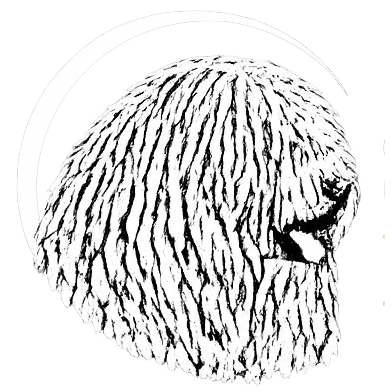
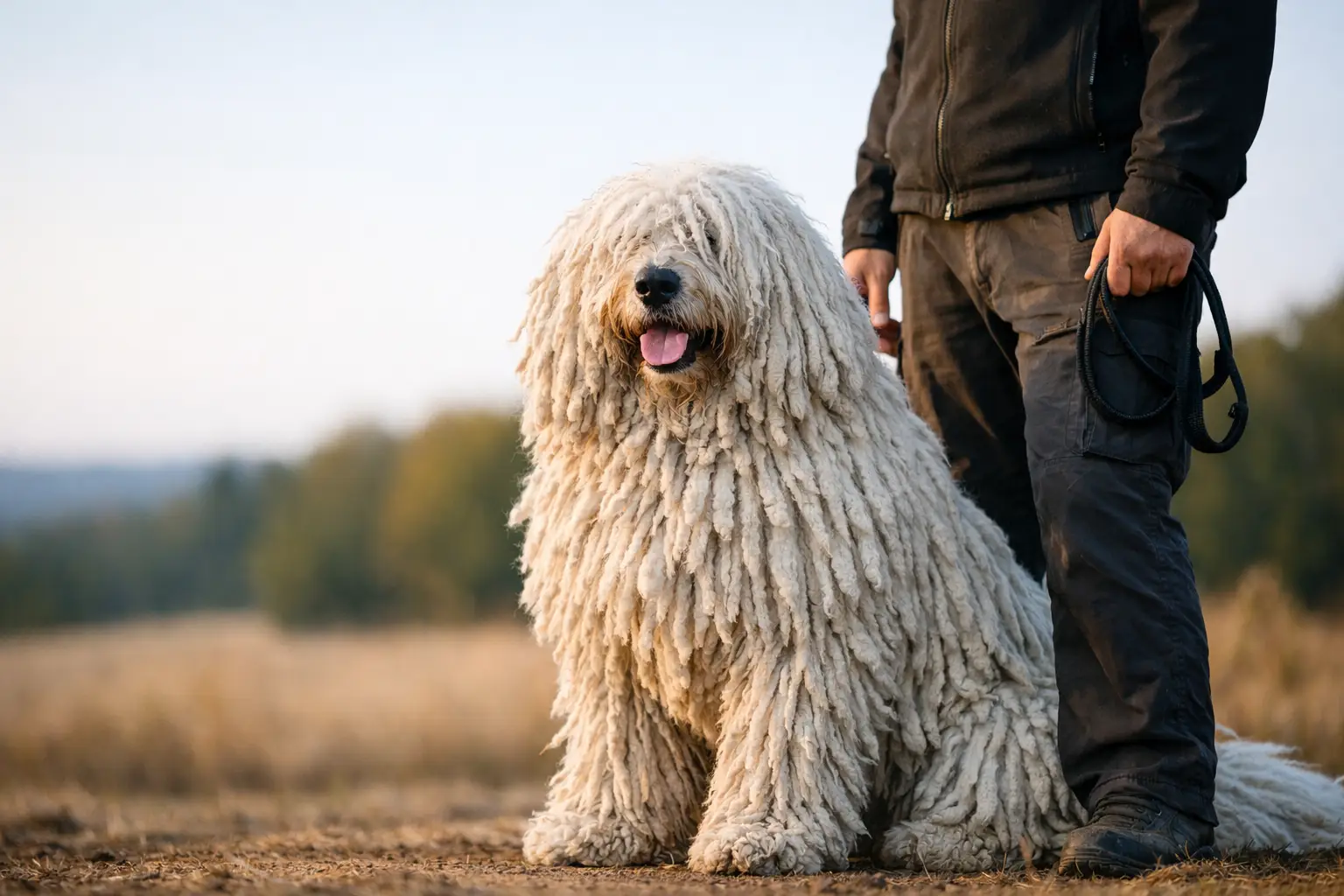
The iconic corded coat gives the Komondor its unmistakable silhouette and provides meaningful protection in its traditional working role. It also requires informed care. A mature corded coat is not brushed like the coat of a retriever or shepherd. Instead, new coat sections are separated by hand so that cords can form correctly and remain clean at the skin.
This work begins when the puppy coat changes and mats start to develop. Regular handling is essential. If neglected, the coat can become a dense, uncomfortable mass that traps moisture and dirt. Owners must learn how to separate cords, inspect the skin, dry the dog thoroughly after bathing, and keep the coat hygienic around the mouth and rear.
Bathing a fully corded adult is a project. The challenge is usually not washing the dog but drying it completely. Damp cords can take a very long time to dry and may develop odor or skin problems if moisture remains. Some owners use professional drying equipment, while others plan baths around warm, dry weather and allow ample time for careful drying. There is no shortcut that replaces regular coat inspection.
The coat is one reason a Komondor should come from a breeder committed to correct breed type. Texture, density, and proper coat development matter. So does breeder guidance, because new owners should not be expected to understand cord care without support.
Exercise, Space, and Daily Life
Despite its size, the Komondor is not necessarily a nonstop endurance athlete. Its work traditionally required watchfulness, bursts of decisive action, and the ability to remain outdoors in varied conditions. Most adults benefit from a securely contained area, daily walks, training sessions, and time with their family. Young dogs need sensible exercise that protects developing joints rather than forced running or repetitive impact.
A large acreage alone does not solve a dog’s needs. Fencing must be dependable, and a Komondor should not be allowed to patrol beyond its property line. Its guardian instincts make roaming especially unwise. Likewise, a long walk in a crowded public setting is not automatically better than structured activity at home. The right amount and type of exercise depend on the dog’s age, health, temperament, climate, and living situation.
Expect a dog that notices. A Komondor may bark when it detects something unusual, especially at night. This alertness is part of the breed’s heritage, but it should be managed. Teach the dog that you have heard the alert and can take responsibility. Secure fencing, supervised outdoor time, and a predictable household routine reduce unnecessary territorial stress.
Choosing a Puppy With the Future in Mind
A Komondor is a long-term responsibility, so the source of the puppy matters profoundly. Appearance alone is not enough. Ask about pedigree, health testing, parental temperament, structure, coat quality, and the breeder’s goals for preserving the breed. A responsible breeder should be able to explain why a particular pairing was made and what qualities are expected from it.
For international buyers, proper pedigree documentation and safe transport planning deserve the same seriousness as the puppy selection itself. A breeder experienced in export should communicate clearly about timing, veterinary requirements, travel arrangements, and the paperwork needed for the destination country. The process should feel organized and transparent, never rushed or vague.
At Somogyi Betyár Kennel, the purpose of breeding is not simply to produce striking puppies. It is to preserve the authentic Hungarian Komondor: sound in body, stable in character, correct in coat, and worthy of its historic role. That standard matters because every placement affects both a family’s future and the reputation of this rare national treasure.
Ask a breeder what support is available after the puppy goes home. New owners may need advice on coat separation, feeding, training milestones, adolescent behavior, or travel. A breeder who remains invested in the dog’s life offers something far more valuable than a transaction: knowledgeable guidance when it is most needed.
Is the Komondor the Right Dog for You?
The best Komondor owners do not want a dog that loves everyone. They want a thoughtful, deeply loyal guardian with a distinct heritage and the confidence to stand watch. They appreciate that the breed’s independence is not a flaw to erase, but a quality to understand and guide.
If your household can provide boundaries, patient training, secure space, regular coat care, and lifelong respect for a guardian’s nature, a Komondor can become an extraordinary companion. Give this breed a purposeful home and a steady hand, and it will offer the rare kind of loyalty that has protected Hungarian homes and flocks for generations.