
A guardian dog’s value is rarely measured in dramatic confrontations. On a well-run property, the real proof is quieter: livestock settle, boundaries are respected, and the dog watches without needing constant direction. This representative Komondor farm guardian case study examines what thoughtful placement, patient development, and correct expectations can look like when a young Komondor joins a working farm.
The Komondor was not developed to be a casual outdoor pet or a dog that follows commands mechanically. For generations, this Hungarian guardian protected stock with independence, judgment, courage, and a deep attachment to its territory. Those instincts remain meaningful today, but they require an owner who understands that a serious guardian is shaped by both heritage and management.
The Farm and the Guardian’s Job
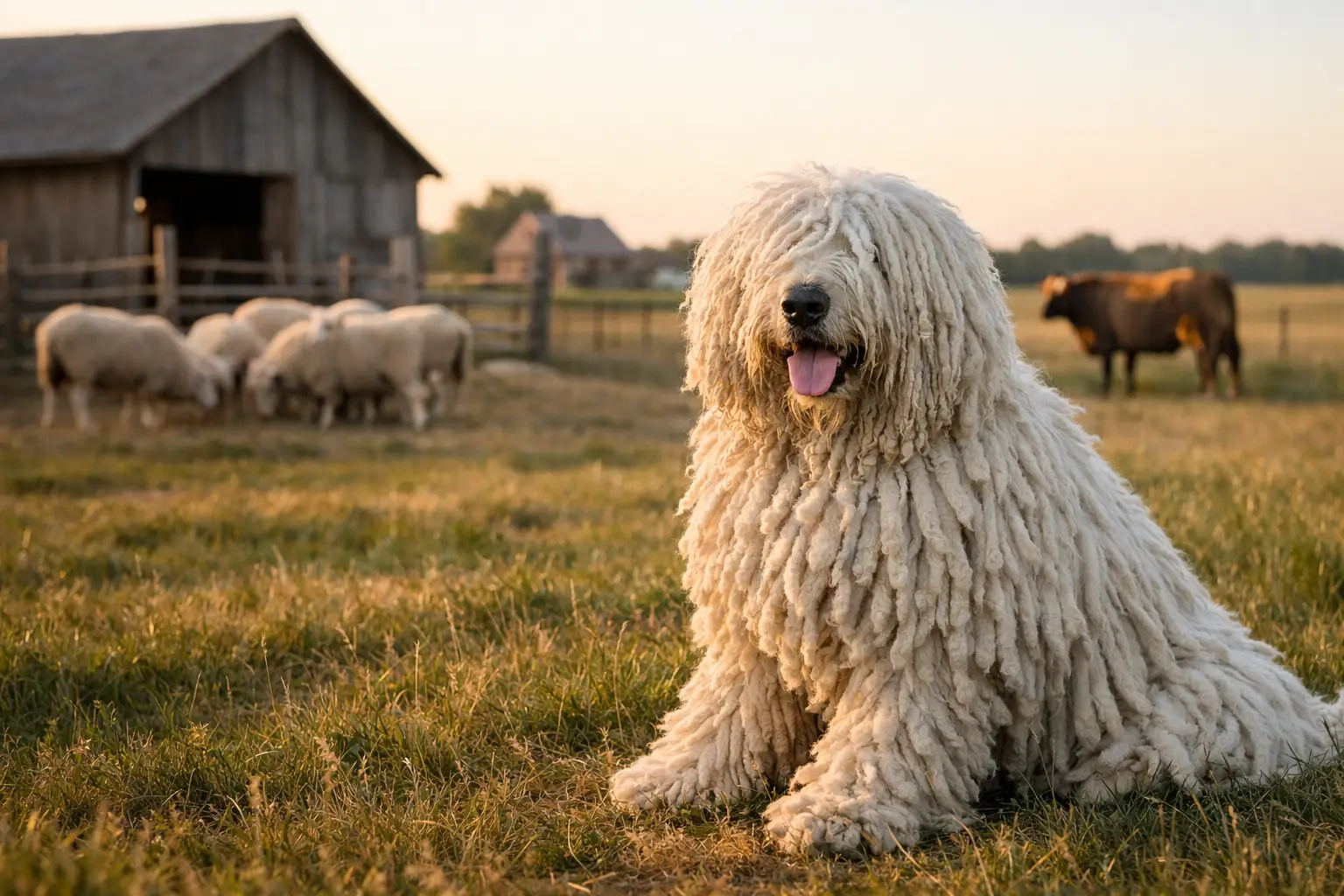
The setting was a mid-sized rural property with fenced pasture, a barn area, poultry pens, and a small flock of sheep. The owners wanted a dog that could live with the animals, alert them to unusual activity, and create a visible protective presence around the property. They did not need a dog to herd. They needed a guardian that could distinguish ordinary farm life from a genuine concern.
The family had experience with dogs, but not with livestock guardian breeds. Before bringing home their Komondor, they adjusted their expectations. A Komondor would not behave like a retriever waiting eagerly for the next task. It would observe, assess, and often make decisions at a distance from its people. That independent character is not a weakness. It is central to the breed’s traditional purpose.
The owners also recognized a key trade-off. A dog with authentic guarding instincts needs more than open land. It needs secure boundaries, consistent routines, controlled introductions, and owners willing to lead calmly. Giving a guardian breed freedom before it understands its home territory can create avoidable problems.
Choosing the Right Young Komondor
A working placement begins long before the puppy reaches the farm. Structure, health, temperament, and pedigree all matter because the dog must grow into a physically capable adult with a stable mind. A Komondor should be watchful without being needlessly reactive, confident without being reckless, and strongly bonded to its family while remaining capable of independent work.
In this case, the owners selected a puppy from documented Hungarian champion bloodlines with careful attention to the parents’ temperament and correct breed type. They were not looking for a novelty or an oversized white dog with cords. They wanted a true Komondor with the substance, protective instinct, coat quality, and balanced character expected of the breed.
The puppy arrived at an age when early socialization could continue naturally. The family introduced it to the sounds of tractors, gates, feed buckets, visitors, poultry, and livestock movement without overwhelming it. Each experience was calm and supervised. The goal was not to make the puppy friendly with every stranger, but to teach it that normal farm activity did not require alarm.
Early Bonding With Livestock
At first, the young Komondor had limited, supervised access to the sheep and poultry areas. This stage was not about expecting protection. It was about building respect. Puppies are curious, playful, and still learning self-control. A guardian prospect that chases, pesters, or plays too roughly with stock must be redirected immediately and consistently.
The owners used smaller, controlled spaces near the livestock rather than turning the puppy loose across the entire property. The dog could rest near the animals, smell them, and observe their patterns. Short corrections for inappropriate behavior were clear and unemotional. Quiet praise followed calm behavior. Over time, the animals became part of the dog’s ordinary environment rather than an exciting new stimulus.
This process cannot be rushed. Some Komondors mature quickly in presence and seriousness; others need more time to develop reliable judgment. Expecting a six-month-old puppy to perform like a finished adult guardian is unfair to the dog and risky for the livestock.
What Changed as the Dog Matured
By adolescence, the Komondor had begun to patrol naturally around the barn and pasture perimeter. The owners noticed that the dog preferred positions with a clear view of gates, driveways, and the edge of the property. At night, it was more alert and more vocal when unfamiliar movement occurred beyond the fence.
That barking was not treated as a nuisance by default. A Komondor’s voice is one of its most effective deterrents. Still, the family learned to investigate alerts rather than simply shouting for silence. When the dog barked at a passing vehicle, a loose animal, or an unfamiliar person near the boundary, the owners calmly acknowledged the situation and showed the dog that they were aware. This helped reinforce that the family, not the dog alone, controlled the property.
The greatest improvement was not a single dramatic event. It was the growing steadiness of the dog. Sheep moved past it without anxiety. Poultry continued feeding while it rested nearby. The Komondor no longer treated routine farm sounds as suspicious, yet remained aware when something was genuinely different.
The Management Decisions That Made the Difference
This Komondor farm guardian case study did not succeed because the dog was left alone to “figure it out.” It succeeded because natural ability was given a proper framework. The owners maintained secure fencing, especially during adolescence, when curiosity and territorial testing can increase. They did not allow unknown visitors to enter livestock areas without supervision, and they gave the dog a protected place to rest away from constant activity.
Feeding was managed carefully as well. The dog was fed on a predictable schedule in a place where livestock could not crowd it. This reduced resource-related tension and gave the owners daily opportunities to observe appetite, physical condition, and behavior.
Coat care became part of the routine rather than an occasional chore. A Komondor’s corded coat is extraordinary, but it requires knowledgeable maintenance. The owners regularly checked the developing cords, separated them by hand where needed, kept the coat dry and clean around muddy areas, and monitored the skin. On a farm, burrs, moisture, and debris can become problems if neglected.
They also continued basic obedience. A reliable recall, a calm response to handling, and the ability to move the dog away from a gate or livestock pen are practical safety skills. Training did not remove the Komondor’s independence. It gave the owners a clear line of communication when it mattered.
What the Owners Would Do Differently
Their main lesson was that they would have prepared visitor protocols earlier. A mature Komondor is naturally discerning around strangers, and that is part of its value as a guardian. However, delivery drivers, farm help, veterinarians, and friends need a consistent system. The dog should be secured or introduced under control before unfamiliar people enter its territory.
They also learned not to compare the Komondor to a more social, highly trainable companion breed. The dog was affectionate with its family, patient with the animals it knew, and deeply devoted to its home. It was not expected to welcome every guest enthusiastically. Respecting that distinction prevented frustration and allowed the owners to appreciate the breed for what it is.
For properties with frequent public traffic, weak fencing, close neighbors, or owners who are away most of the day, a Komondor may not be the easiest choice. The breed can thrive on a family farm, but it is not an automatic solution for predator control or property security. Its success depends on the fit between the dog, the environment, and the people responsible for it.
A Guardian Is a Long-Term Commitment
A well-bred Komondor brings more than an imposing appearance to a farm. It brings an ancient protective character that has survived because capable owners recognized its purpose. When placed with patience and respect, the dog’s loyalty becomes visible in the calm confidence with which it occupies its ground.
For future owners, the best starting point is an honest conversation about the property, livestock, family routine, fencing, visitors, and long-term goals. Somogyi Betyár Kennel believes a Komondor deserves a home that values both its remarkable heritage and the careful guidance needed to let that heritage shine.