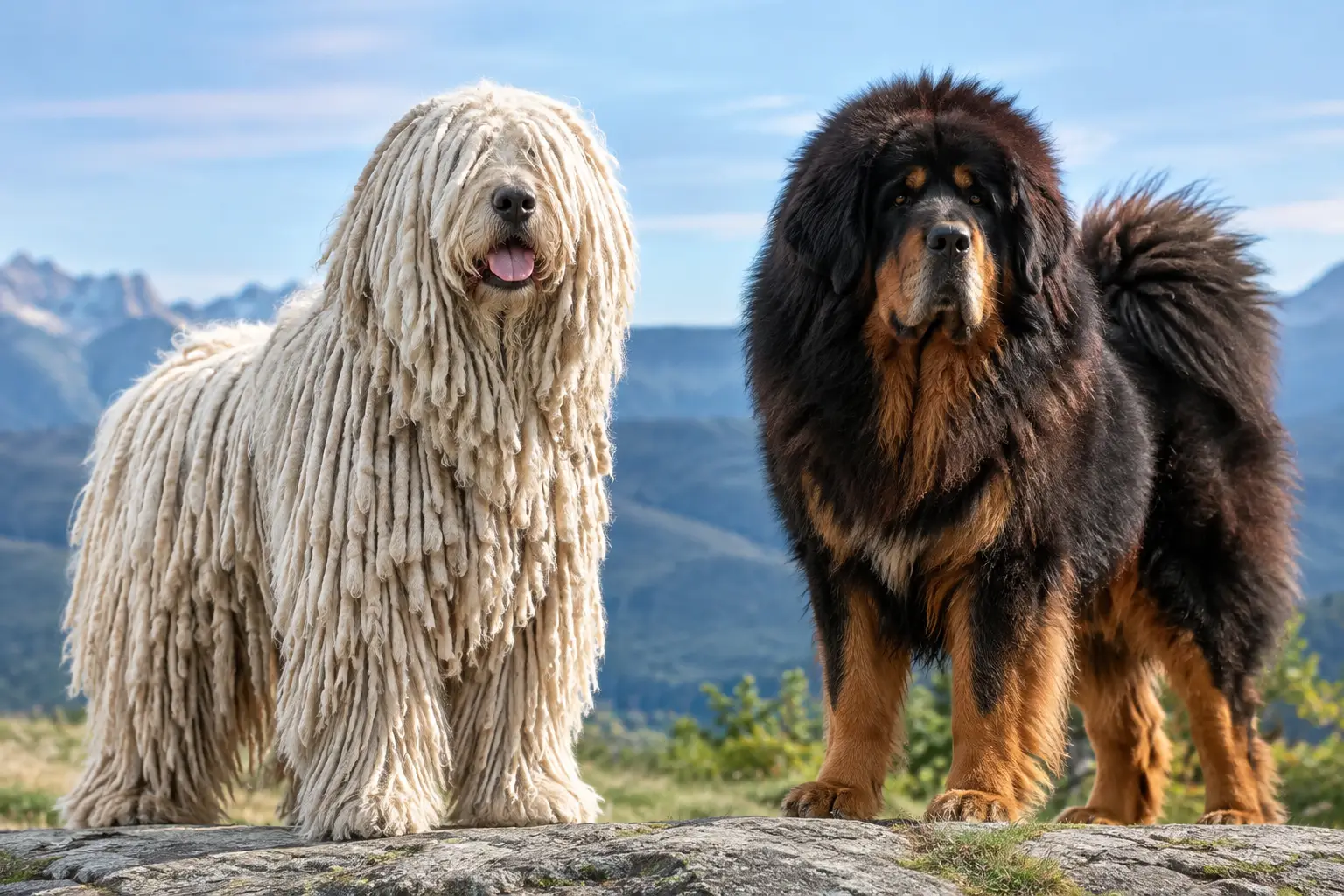
A Komondor versus Tibetan Mastiff comparison is not really about choosing the more impressive-looking dog. Both are ancient guardian breeds with commanding presence, deep loyalty, and an instinct to take their responsibilities seriously. The real question is which dog fits your land, household, experience, and willingness to live with a powerful independent thinker for many years.
For the right owner, either breed can be extraordinary. For the wrong owner, either can become too much dog. These are not casual pets selected for appearance alone. They were shaped by demanding work, selective breeding, and generations of partnership with people who needed trustworthy protection.
Komondor Versus Tibetan Mastiff at a Glance
The Komondor is Hungary’s historic flock guardian, developed to live among sheep and protect them from predators. A mature Komondor is large, athletic, alert, and unmistakable beneath a dense coat that naturally forms cords. Its character is purposeful: calm when nothing is wrong, decisive when it believes something requires attention.
The Tibetan Mastiff developed as a guardian of homes, monasteries, and livestock in the Himalayan region. It is heavily built, imposing, and often more openly aloof with strangers. A Tibetan Mastiff commonly has a fuller mane and a more mastiff-like outline, while the Komondor has a leaner, more agile guardian-dog structure beneath its distinctive corded coat.
Both breeds need secure fencing, early socialization, thoughtful leadership, and owners who respect their guardian instincts. Neither is a breed that should be expected to greet every visitor, dog, or unfamiliar situation with automatic enthusiasm.
Temperament: Two Different Kinds of Serious
The Komondor is often deeply devoted to its own people while remaining reserved with strangers. A well-bred, properly raised dog should not be nervous or indiscriminately aggressive. Instead, it should be observant, confident, and capable of assessing a situation before reacting. The breed’s traditional job required independent judgment, so blind obedience is not its defining trait.
At home, many Komondors are surprisingly composed. They watch, listen, and position themselves where they can monitor the family and property. Their affection is real, but it is often expressed through quiet closeness and watchful companionship rather than constant demands for attention.
The Tibetan Mastiff can be equally loyal, but it may be more territorial and more selective about strangers. Many are especially vocal at night, reflecting their historical role as nighttime guardians. This can be a major consideration for suburban owners with close neighbors.
Individual temperament always matters. Bloodline quality, early handling, social exposure, and clear household rules shape the adult dog. A responsible breeder does not treat “protective” as a substitute for stable nerves. True guardian character includes soundness, self-control, and the ability to distinguish ordinary life from a genuine concern.
Size, Structure, and Physical Presence
A Komondor is generally a tall, powerful dog with substantial bone and surprising mobility. Adult males commonly stand at least 27.5 inches at the shoulder, with females at least 25.5 inches. Their weight varies with sex, structure, and conditioning, but this is a large working breed, not a fluffy oversized lap dog.
Tibetan Mastiffs are also very large, often broader and heavier in appearance. Their size can make them seem more formidable at first glance, particularly males with abundant mane and coat. Yet height and weight alone do not tell the whole story. A dog built for guardian work needs balance, durable movement, and a body that can function for years, not merely a dramatic outline.
The Komondor’s white cords are more than a visual signature. Historically, the coat helped the dog blend with sheep and offered protection in harsh outdoor conditions. Its distinctive appearance has become famous worldwide, but the correct coat and correct working temperament should always be preserved together.
Coat Care Is Different, Not Easier
Prospective owners sometimes assume the Tibetan Mastiff is simpler to maintain because its coat is not corded. That is only partly true. The Tibetan Mastiff’s dense double coat requires regular brushing, especially during seasonal shedding periods when the amount of loose coat can be considerable.
A Komondor’s coat does not require conventional brushing once cords develop, but it does require knowledgeable, consistent hands-on care. Cords must be separated to prevent dense mats, and bathing and drying demand planning. A large wet corded coat takes time to dry thoroughly. Owners must also monitor skin condition, cleanliness around the mouth and rear, and the formation of healthy, separated cords.
This is not a breed for someone who wants a low-maintenance coat. It is a breed for someone who appreciates a historic coat and is ready to care for it properly. The reward is incomparable: a mature, correctly corded Komondor has an appearance no other breed can replicate.
Training: Respect Works Better Than Force
Neither the Komondor nor the Tibetan Mastiff responds well to harsh, repetitive training. Both were bred to think independently. They need owners who are calm, consistent, fair, and able to set boundaries without turning every interaction into a confrontation.
A Komondor puppy should begin socialization early, with carefully managed exposure to visitors, surfaces, travel, grooming, household routines, and appropriate dogs. The objective is not to erase its guardian nature. It is to teach the young dog that its owner directs the situation and that ordinary events do not require intervention.
Basic obedience, reliable recall within safe limits, leash skills, crate comfort, and cooperative handling are essential. Training must continue as the dog matures, because guardian breeds often become more aware of territory and strangers as adulthood approaches.
For families, supervision is non-negotiable. A stable Komondor can be a devoted family dog, but children must learn respectful behavior around it, and adults must manage introductions, gates, visitors, and play appropriately. The same standard applies to a Tibetan Mastiff.
The Best Home for Each Breed
A Komondor is often an excellent choice for owners who value a serious guardian with traditional flock-protection heritage, a calmer indoor manner, and a close bond with its family. It needs space, but that does not necessarily mean a vast farm. A securely fenced property, daily purposeful activity, and an owner who understands guardian behavior can be more valuable than acreage without guidance.
The Tibetan Mastiff may suit an owner who prefers its heavier mastiff type, accepts its often stronger nighttime vigilance, and has the environment to manage a large, territorial dog. Its independent nature can be especially challenging where visitors, delivery traffic, or neighborhood activity are constant.
Apartment living is rarely ideal for either breed. A guardian dog needs room, privacy, and a predictable routine. More importantly, it needs an owner willing to prevent rehearsal of unwanted behavior. Repeated fence-running, uncontrolled barking, and chaotic visitor encounters can become deeply ingrained habits.
Choosing a Breeder Matters More Than a Breed Label
Because both breeds are rare, striking, and expensive to raise correctly, buyers should be especially careful about breeder standards. Ask about documented pedigree, health testing, structure, temperament, puppy raising practices, and the breeder’s support after placement. A puppy should never be selected solely from photos of an impressive coat or a large head.
For a Komondor, preservation of authentic Hungarian bloodlines and correct breed character deserves particular attention. Somogyi Betyár Kennel approaches breeding as stewardship: protecting the Komondor’s sound health, stable temperament, working ability, correct structure, and traditional coat for future generations.
A responsible breeder will also ask questions of the buyer. That is a positive sign. The best placement is not the fastest sale. It is the home where a puppy can mature into the steady, confident guardian it was bred to become.
Which Guardian Is Right for You?
Choose the Komondor if you are drawn to a uniquely Hungarian guardian breed with an extraordinary corded coat, agile working structure, and quiet but serious devotion to its family. Choose the Tibetan Mastiff if its heavier type, mountain-dog character, and often more pronounced territorial reserve fit your experience and home setting.
Neither choice should be made quickly. Meet adult dogs if possible, study the breed beyond puppy photographs, and be honest about your fencing, time, grooming commitment, and comfort with independent guardian behavior. The right dog will not simply decorate your property. It will become a loyal, watchful part of the life you build there.