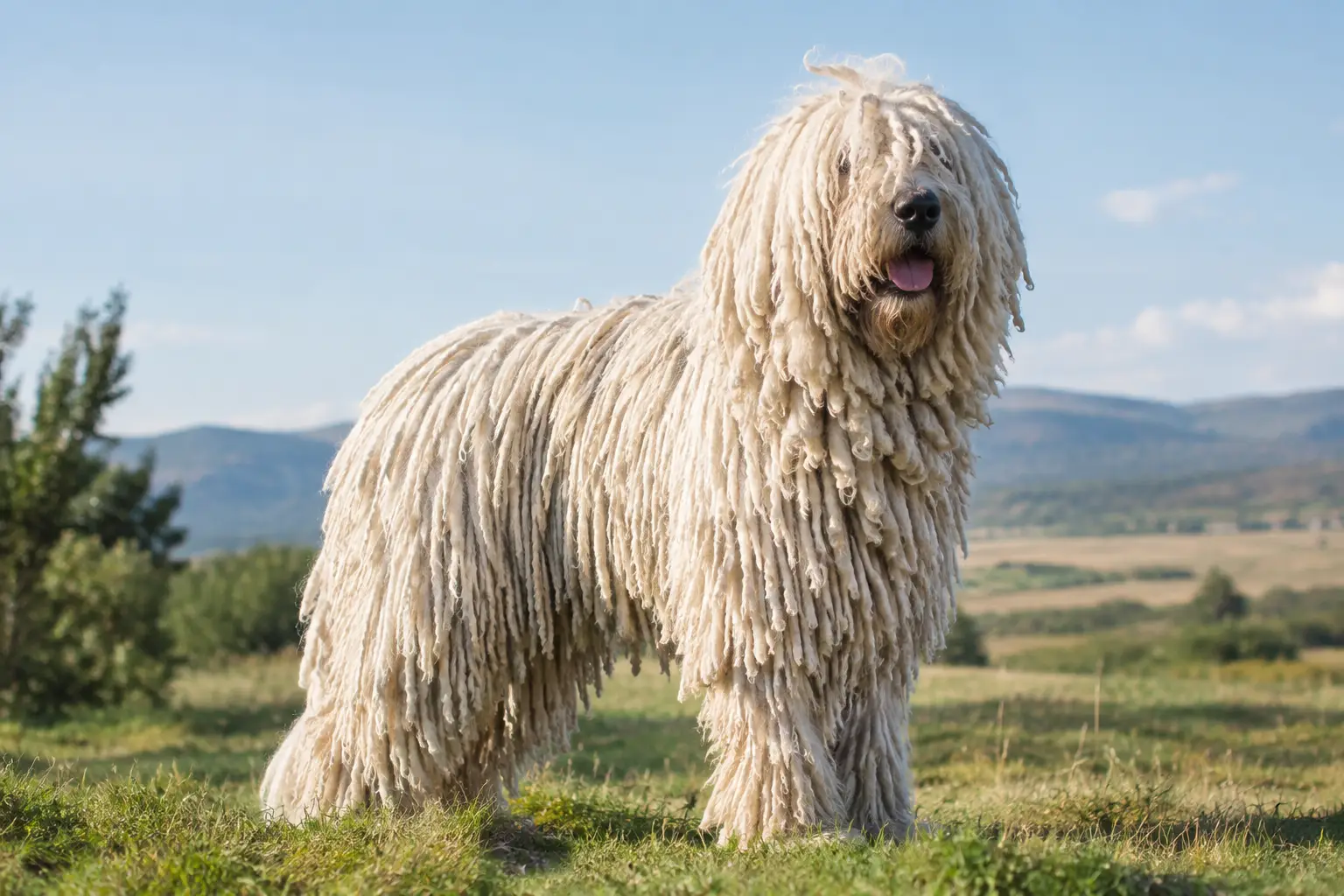
A mature Komondor does not simply look large. Correct Komondor size carries purpose: enough height, bone, substance, and balance to perform the breed’s historic work as a confident livestock guardian, while still moving freely and efficiently. For a family considering this rare Hungarian breed, understanding size means looking beyond a number on a scale. It means recognizing the structure and development behind the famous corded coat.
The Komondor was developed to live and work with livestock in demanding conditions. Its body needed to be powerful enough to deter a threat, agile enough to cover ground, and sound enough to remain active for years. A well-bred dog should communicate strength without heaviness, and dignity without exaggeration. That balance is one of the reasons careful breeding and documented Hungarian bloodlines matter.
Komondor Size at Maturity
According to the breed standard, adult male Komondors should stand at least 27.5 inches at the shoulder, while females should stand at least 25.5 inches. These are minimum heights, not a reason to pursue extreme height at the expense of correct proportions, health, or movement.
In real life, many adult males stand roughly 28 to 30 inches or more at the shoulder, and females are commonly around 26 to 28 inches. Weight varies substantially with sex, frame, conditioning, and individual genetics. A well-conditioned adult female may weigh approximately 80 to 100 pounds, while males often weigh 100 pounds or more. Some strong males naturally exceed that range.
However, weight is the least revealing measurement on its own. The Komondor’s dense bone, muscle, and distinctive coat can create a far larger visual impression than a number suggests. A dog can be tall yet narrow, heavy yet poorly conditioned, or dramatically coated while lacking the underlying body that defines the breed. For this reason, experienced breeders evaluate the whole dog rather than advertising size as an isolated selling point.
Height is measured at the shoulder
When comparing adult dogs, height is measured from the ground to the top of the withers, the highest point of the shoulder blades. It is not measured to the head or the top of the coat. Because the Komondor carries a full, heavy corded coat, casual visual estimates can be very misleading.
A properly built Komondor should appear slightly longer than tall, with a broad, deep chest, substantial bone, and a strong body beneath the cords. The outline should be powerful but never coarse or clumsy. Correct size supports the guardian’s ability to move with surprising ease.
Why Correct Size Matters More Than Giant Size
Prospective owners are understandably drawn to an impressive guardian. Yet a responsible breeder does not select solely for the biggest puppy in a litter or the tallest adult in a pedigree. Oversize without structural balance can compromise the qualities that made the Komondor valuable for generations.
An excessively heavy dog may place greater strain on joints and lose athleticism. A tall dog with insufficient bone or weak construction may not have the strength and endurance that a guardian breed requires. Conversely, a dog that falls below appropriate size may lack the imposing, substantial presence expected of a traditional Komondor.
The goal is not to produce a giant novelty dog. The goal is to preserve a correct Hungarian guardian: large, durable, balanced, self-assured, and capable. This is why pedigree knowledge is essential. Reliable bloodlines help a breeder understand not only what an adult dog looks like today, but what it is likely to pass on in body, coat, temperament, and working character.
How Big Is a Komondor Puppy?
Komondor puppies are substantial from an early age, but they should not be judged as miniature versions of the finished adult. Growth is uneven. A youngster may go through a leggy stage, then add chest, muscle, and body as it matures. Littermates can also develop at different rates while still becoming correct adults.
At eight weeks, a healthy Komondor puppy is often already noticeably solid and large-boned compared with many breeds. Yet it is impossible to predict final adult height or weight precisely from one early measurement. Genetics from both parents, the depth of the pedigree, nutrition, exercise, sex, and individual development all play a role.
A quality breeder can offer realistic expectations based on the parents and close relatives, but should never promise an exact final weight. Puppies are living individuals, not products built to a fixed specification. What matters most is steady, healthy development and a puppy whose proportions, temperament, and overall quality reflect the breed.
The first two years are formative
Most Komondors achieve much of their adult height during the first year, but they continue to mature well beyond that point. The chest broadens, muscle develops, and the body gains adult substance over time. Many dogs do not look fully mature until 18 to 24 months, sometimes later in strong males.
Their coat development also changes the picture. The white puppy coat gradually begins to form mats and cords as the young dog matures. As cords lengthen and become more abundant, the Komondor may look even larger than its actual frame. Proper coat separation and maintenance are important, but the coat must never be used to hide poor condition or weak structure.
Feeding for Sound Growth, Not Maximum Growth
The temptation to make a large-breed puppy grow faster is understandable and harmful. Overfeeding can encourage rapid growth, excess body weight, and unnecessary stress on developing joints. A future guardian needs controlled, even development rather than accelerated size.
A veterinarian and breeder familiar with giant and large guardian breeds can help establish a sensible feeding plan. The right diet depends on the puppy’s age, current body condition, activity level, and growth pattern. Owners should be able to feel the ribs beneath a healthy covering of flesh, see an appropriate waist when viewing the dog from above, and avoid the round, heavy appearance often mistaken for good growth.
Exercise should be equally thoughtful. Young Komondors need room to explore, play, and learn, but forced running, repetitive high-impact activity, and excessive jumping are not appropriate while joints are developing. Mental maturity deserves equal attention. A Komondor is not merely a big white dog. It is an intelligent, independent guardian that benefits from patient socialization, clear boundaries, and experienced leadership.
Space, Travel, and Everyday Life With a Large Komondor
A mature Komondor needs more than a large yard. It needs secure fencing, meaningful supervision, and an owner who understands guardian instincts. This breed was bred to make independent decisions about its territory. Its size and protective nature make early training and responsible management essential, particularly around visitors, unfamiliar dogs, and changing household situations.
Inside the home, a mature Komondor needs room to turn, rest comfortably, and remain part of family life. The breed can be calm indoors when its needs are met, but it is not a casual apartment choice for most households. Owners should also plan for the practical realities of a large dog: a properly sized crate, vehicle space, quality veterinary care, and grooming time for the corded coat.
International buyers should consider size when planning transport as well. A growing puppy can travel safely with suitable arrangements, while adult transport requires careful crate sizing, documentation, and experienced coordination. Responsible export is not only about reaching a destination. It is about protecting the dog’s welfare throughout the journey.
What to Ask a Breeder About Komondor Size
When discussing a puppy, ask to learn about the parents’ heights, general weights, body proportions, health testing, and temperaments. Photographs can be helpful, but videos showing the dogs standing and moving offer a clearer impression of construction. Ask about adult relatives as well, especially if you are seeking a dog for showing, breeding, livestock work, or a particular lifestyle.
Be cautious of claims centered only on extraordinary size. A reputable breeder should be ready to explain how breeding decisions protect soundness, correct coat, stable character, and traditional type. At Somogyi Betyár Kennel, preserving these connected qualities is central to honoring the Komondor as Hungary’s national treasure.
The right Komondor will fill your home and your field with an unmistakable presence, but its greatest value is not measured in pounds or inches. Choose the dog whose size is supported by health, structure, heritage, and the steady guardian temperament that has defined this remarkable breed for centuries.