

A flock can be quiet one moment and in danger the next. Coyotes, stray dogs, raccoons, foxes, and aerial predators do not announce themselves at the gate. For the right property and the right owner, the answer to “do Komondors protect chickens?” is yes – but that answer comes with a responsibility many first-time livestock guardian owners underestimate.
The Komondor was developed in Hungary as a serious guardian of livestock. Its traditional work was not to herd animals from place to place, but to live among them, observe its territory, and meet a threat with calm determination. That heritage gives the breed real potential around chickens. It does not mean every Komondor, in every setup, will be safe and effective with poultry from day one.
Do Komondors Protect Chickens Reliably?
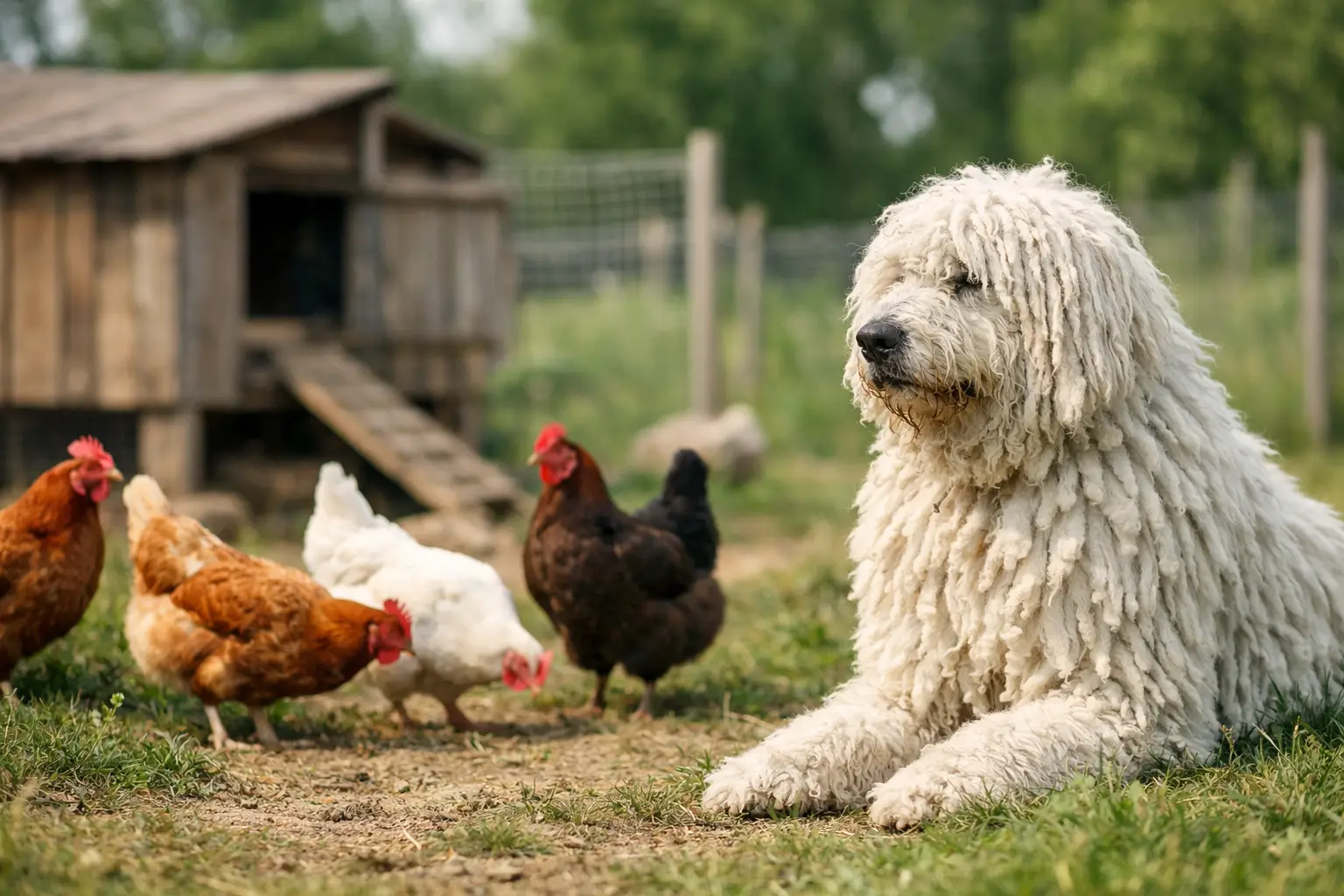
A mature, properly raised Komondor can be an excellent deterrent and protector for a chicken flock. The breed is naturally territorial, watchful, independent, and deeply committed to its home and family. A Komondor does not need to be taught that unfamiliar predators do not belong near its birds. Its instinct is to notice changes, patrol boundaries, and respond when something is wrong.
That said, protection is different from guaranteed compatibility. Chickens move quickly, flap suddenly, and can trigger chase behavior in an inexperienced young dog. A Komondor puppy is still a puppy, regardless of its pedigree or guardian heritage. Adolescence can be especially challenging: the dog has growing confidence, size, and energy, but not yet the judgment of a settled adult guardian.
The most dependable poultry guardians are usually mature dogs that have been introduced thoughtfully, corrected fairly, and given clear boundaries. Their protection is also strongest when the property itself supports their work. Secure fencing, safe nighttime housing for birds, and a well-managed feeding routine remain necessary. No guardian dog should be expected to compensate for an open, poorly planned farmyard.
What Makes the Komondor Different
The Komondor is not a general-purpose farm dog. It is a heritage livestock guardian breed with a strong sense of ownership over its territory. This can be a great advantage for chicken keepers who need a dog that takes its role seriously, especially on rural acreage where predators are a genuine concern.
Unlike breeds selected to work closely with constant human direction, the Komondor has been bred to make decisions independently. At night, when chickens are most vulnerable and their owner is asleep, that independence matters. A good Komondor may remain alert to sounds and movement well beyond the coop, often deterring trouble before a direct confrontation occurs.
There are trade-offs. This same protective nature means the breed requires owners who understand management. A Komondor may be reserved with visitors, suspicious of unfamiliar animals, and unwilling to accept every person who enters the property without a proper introduction. This is not a breed to leave unsupervised with delivery workers, casual visitors, or loose neighborhood dogs.
Its famous corded coat is also functional, not merely dramatic. The dense coat traditionally helped protect the dog from weather and from the teeth of predators. It requires knowledgeable care, particularly as cords form and mature. Owners should be prepared for regular coat separation, drying time after wet weather, and careful inspection for debris or skin concerns. A working guardian must be healthy and comfortable to perform its job well.
Raising a Komondor Safely With Poultry
Success begins before a puppy ever has access to loose chickens. A young Komondor should learn that the coop, run, and birds are part of its normal environment, not a place for excitement. Early exposure is valuable, but it must be controlled. Allowing a puppy to chase chickens because it seems playful can create a habit that becomes dangerous as the dog grows.
Start with secure physical separation. Let the puppy observe chickens through sturdy fencing while you reward calm behavior and interrupt fixation. The goal is not to create a dog that ignores the flock completely. The goal is to create a dog that understands the birds belong there.
As the puppy matures, supervised access can be expanded gradually. Keep sessions short and calm. A puppy that stares intensely, crouches, stalks, barks excessively, or attempts to rush the birds needs more distance and more training before moving forward. Correct inappropriate behavior immediately and consistently, then redirect the dog to a calm task or place.
Do not place a very young puppy alone in a chicken enclosure and assume instinct will teach the right lesson. Some pups are naturally gentle; others are curious, boisterous, or highly stimulated by fluttering wings. Breed instinct provides a foundation, but the owner’s judgment shapes the outcome.
Feed Management Matters
Many avoidable conflicts occur around food. Feed the dog separately from the chickens, remove spilled grain when possible, and do not allow poultry to crowd the dog’s bowl. A Komondor should also not be encouraged to eat dead birds, eggs, or scraps from the coop. Clear routines prevent confusion and protect the dog’s health.
Chickens need their own predator-proof shelter at night, even if a guardian dog is present. The Komondor should be viewed as an added layer of protection, not the only lock on the door. Good husbandry and a capable guardian work together.
Choosing the Right Komondor for a Poultry Property
If chickens are central to your plans, speak openly with the breeder before reserving a puppy or considering an adult dog. A responsible breeder should discuss your acreage, fencing, predator pressure, household activity, other dogs, children, and expectations for the dog’s daily life. A Komondor should never be selected simply because its appearance is impressive or because it is described as protective.
Sound temperament is essential. The right dog is confident and stable, not nervy, chaotic, or indiscriminately aggressive. Correct structure and sound health matter as well. A guardian that will patrol uneven ground, endure changing weather, and remain active for years needs the physical quality to do that work.
Documented Hungarian bloodlines offer more than a pedigree to frame. They connect a puppy to generations selected for correct Komondor character, strength, coat, and working aptitude. At Somogyi Betyár Kennel, preserving these traditional qualities is central to every breeding decision. Still, lineage supports potential; it does not remove the need for patient training and responsible ownership.
An adult Komondor can sometimes be a wiser choice for an owner who needs a settled guardian more quickly. However, adult placement requires careful matching. A dog accustomed to one property, species, or routine may need a deliberate transition before it understands its role with a new flock. Ask direct questions about the dog’s history around poultry and other livestock rather than assuming all adults have the same experience.
When a Komondor May Not Be the Best Choice
A Komondor is not ideal for every backyard chicken keeper. If your birds live in a small suburban yard with frequent guests, neighboring dogs at the fence line, and little room for a large guardian to establish space, management can become difficult. The breed needs secure territory, consistent leadership, and owners who respect its protective temperament.
It may also be the wrong fit for someone seeking a dog that welcomes everyone, follows commands instantly in every situation, or requires minimal grooming. Komondors are loyal and affectionate with their own people, but they are not meant to be easygoing social butterflies. Their value lies in their seriousness, discernment, and devotion to what they consider theirs.
For a rural family with suitable fencing, realistic expectations, and a true need for predator awareness, those same traits can be exactly what makes the Komondor exceptional. The relationship is built over time: the dog learns the flock, the boundaries, the household, and the difference between normal life and a threat.
A well-bred Komondor does not need to be constantly busy to be valuable. Often, the greatest sign that the dog is doing its work is a peaceful flock settling into the evening while a watchful guardian rests nearby, fully aware of every sound beyond the fence.