
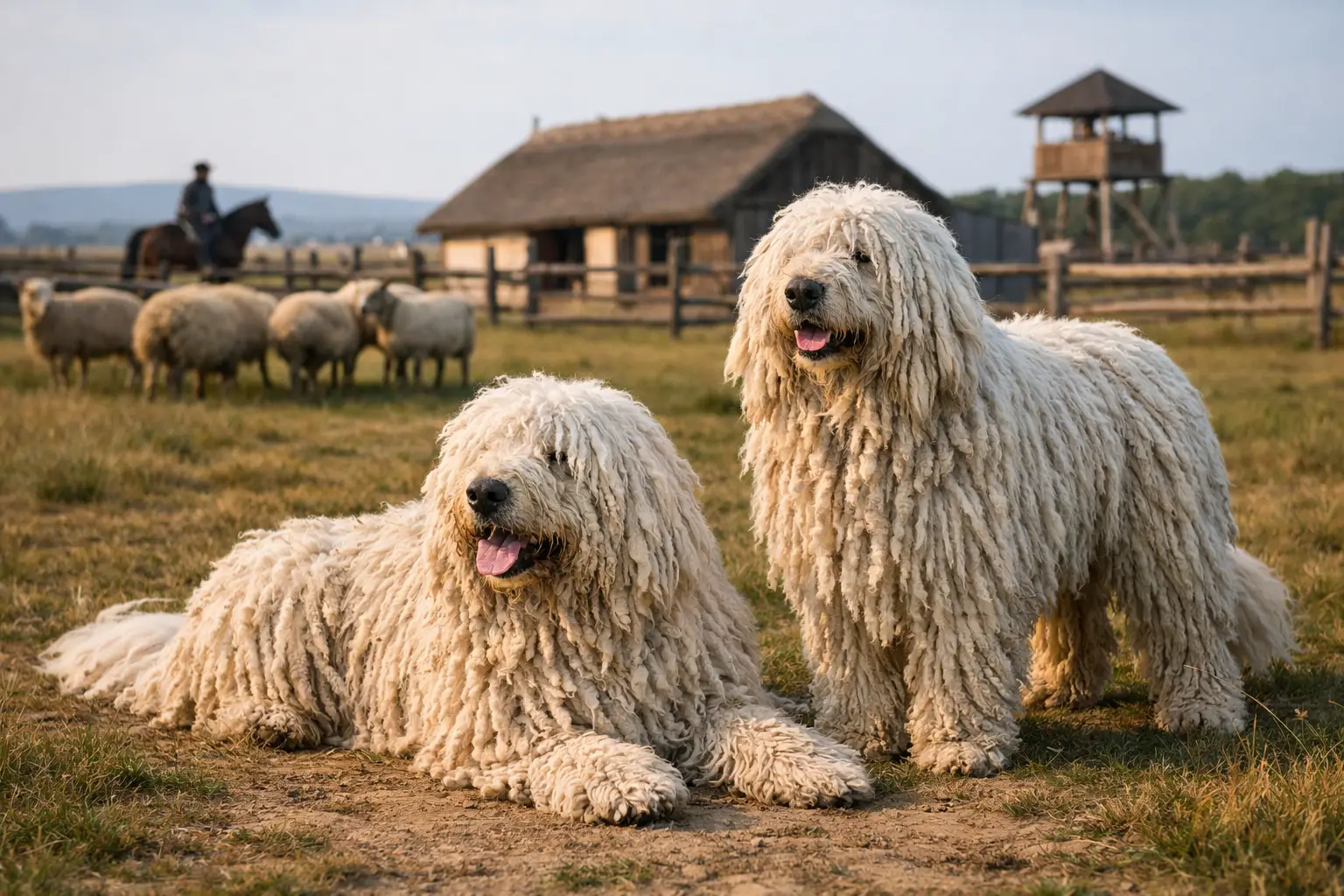
At dusk, a working ranch changes character. The ordinary sounds of gates, feeding buckets, and vehicles give way to movement beyond the fence line: wildlife, unfamiliar people, and the quiet uncertainty that comes after dark. A Komondor ranch protection story begins in that moment, not with dramatic commands or constant barking, but with a dog that has been bred for generations to notice what does not belong.
The Komondor was shaped on the Hungarian plains as a livestock guardian, expected to live close to a flock and make sensible decisions without a shepherd standing beside him every minute. That history still matters. A correct Komondor is not simply an impressive white dog with cords. He is a serious, independent guardian whose protective instinct must be supported by stable temperament, sound nerves, proper upbringing, and responsible ownership.
For ranch owners, acreage families, and people who value a true guardian breed, the Komondor offers something increasingly rare: a dog with a purpose that has not been bred away.
A Komondor Ranch Protection Story Starts Before the Threat
The strongest protection stories are usually quiet ones. A Komondor may position himself between livestock and a distant sound, stand at the edge of the property while watching a visitor arrive, or give a deep warning bark when an unfamiliar animal approaches the barn. Much of his work is deterrence. Predators and intruders often choose the easier path when they understand that a confident guardian is present.
This is why the breed should never be judged by flashy obedience-ring behavior alone. A Komondor is not designed to wait eagerly for instruction in every situation. He was developed to assess his surroundings, remain with those under his care, and respond when he believes it is necessary. That independence is valuable on a large property. It can also be challenging for an owner who expects a highly social, instantly compliant dog.
A ranch is not automatically the right setting simply because it has land. The Komondor needs boundaries, a clear daily routine, secure fencing where appropriate, and an owner who understands that guardian behavior is different from uncontrolled reactivity. Good protection is based on judgment. A dog that treats every passing car, neighbor, or delivery person as a crisis is not demonstrating mature working ability.
The Work Most People Never See
A mature Komondor protects through presence as much as action. His large frame, distinctive coat, confidence, and natural suspicion of unfamiliar activity create a powerful impression. Yet his value is not in intimidation alone. A well-bred dog should be calm with his own people, devoted to his territory, and capable of distinguishing normal ranch life from a genuine concern.
That balance is the result of generations of careful breeding and thoughtful raising. Stable temperament is not an optional extra for a guardian breed. It is central to the breed’s function. A dog that is fearful may bark or react without sound judgment. A dog that is overly sharp may create management problems for the very family he is meant to protect. The correct Komondor is self-assured, observant, and serious without being needlessly confrontational.
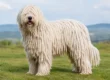
This is particularly important for international buyers who may see photographs of the iconic corded coat and assume the breed is primarily ornamental. The coat is one of the Komondor’s unmistakable treasures, but the breed’s heritage is working heritage. Beneath that coat should be a strong, correct dog with the structure, character, and instincts of a traditional Hungarian guardian.
Protection Is a Partnership
No dog should be expected to replace practical ranch security or owner involvement. A Komondor needs people who will introduce him properly to the property, supervise his development, secure livestock areas, and manage visitors responsibly. He must learn who belongs on the ranch and what ordinary activity looks like.
Early socialization does not mean turning a Komondor into a dog who welcomes every stranger. It means raising a dog who is confident and composed in the world, able to accept the people his owner accepts while retaining his natural awareness. Exposure should be intentional and controlled, especially during puppyhood and adolescence.
A young Komondor also should not be placed alone with vulnerable livestock and expected to perform like a seasoned adult. Protective maturity takes time. Puppies may be curious, playful, and clumsy around animals. Adolescents often test boundaries. The owner’s role is to guide, supervise, and allow the dog to develop steadily rather than forcing responsibility too early.
What Ranch Owners Should Expect From a Komondor
A Komondor is often most comfortable when he has a meaningful place within the household or property. Some live primarily with livestock, while others protect a home, barn area, perimeter, or family acreage. The right arrangement depends on the livestock involved, local predator pressure, fencing, climate, the dog’s temperament, and the owner’s experience.
Owners should expect a guardian that is watchful, territorial, and vocal when he identifies a concern. Night barking can be part of legitimate guardian behavior, particularly where coyotes or other predators are active. It should be managed with consideration for neighbors, but it should not come as a surprise. The Komondor has historically warned first and acted with purpose when needed.
They should also expect grooming commitment. The famous coat must be separated and maintained as it develops into cords. On a ranch, mud, burrs, weather, and debris can add to the work. Some owners keep their dogs in a more practical coat length, while others preserve the full traditional appearance. Neither choice should be made casually. Coat care affects cleanliness, comfort, and the time an owner must devote to the dog.
Exercise needs are often misunderstood. A Komondor does not require endless high-speed activity like a herding or sporting breed, but he does need room, purpose, and regular engagement with his environment. A fenced suburban yard may suit some Komondors in knowledgeable homes, yet a dog bred to survey territory can find close, busy neighborhoods difficult if owners are unprepared to manage his guarding instincts.
Why Heritage and Breeding Decisions Matter
When a family seeks a Komondor for ranch protection, pedigree is more than a document. It is a record that helps preserve the breed’s identity. Responsible breeders study bloodlines, health, structure, temperament, coat quality, and the characteristics that made the Komondor valuable in the first place.
Champion bloodlines do not guarantee that a puppy will become the right ranch dog for every situation. No honest breeder should promise that. Environment, handling, livestock introductions, and maturity all influence the outcome. But documented lineage and selective breeding give buyers a far stronger foundation than choosing a puppy based on appearance, availability, or price alone.
At Somogyi Betyár Kennel, our commitment is to the authentic Hungarian Komondor: a breed with correct type, sound health, stable character, and the traditional guardian qualities that deserve preservation. Placing a puppy means looking beyond the first day of ownership. It means considering the future adult dog, the home he will protect, and the owner who will live with his decisions for many years.
Choosing for the Life Ahead
Before bringing home a Komondor, a prospective owner should ask practical questions. What will the dog protect? Who regularly enters the property? Are there children, neighbors, staff, clients, or service providers to consider? Is the fencing suitable? Is there time to train, groom, and supervise a large guardian breed through adolescence?
The best Komondor ranch protection story is not one built on conflict. It is the story of a dog who settles into his territory, learns his family and animals, and becomes a steady presence that others notice before trouble ever reaches the gate. Give this breed thoughtful breeding, patient guidance, and a life worthy of his heritage, and he will show why Hungary’s great white guardian has earned such enduring respect.